TL;DR
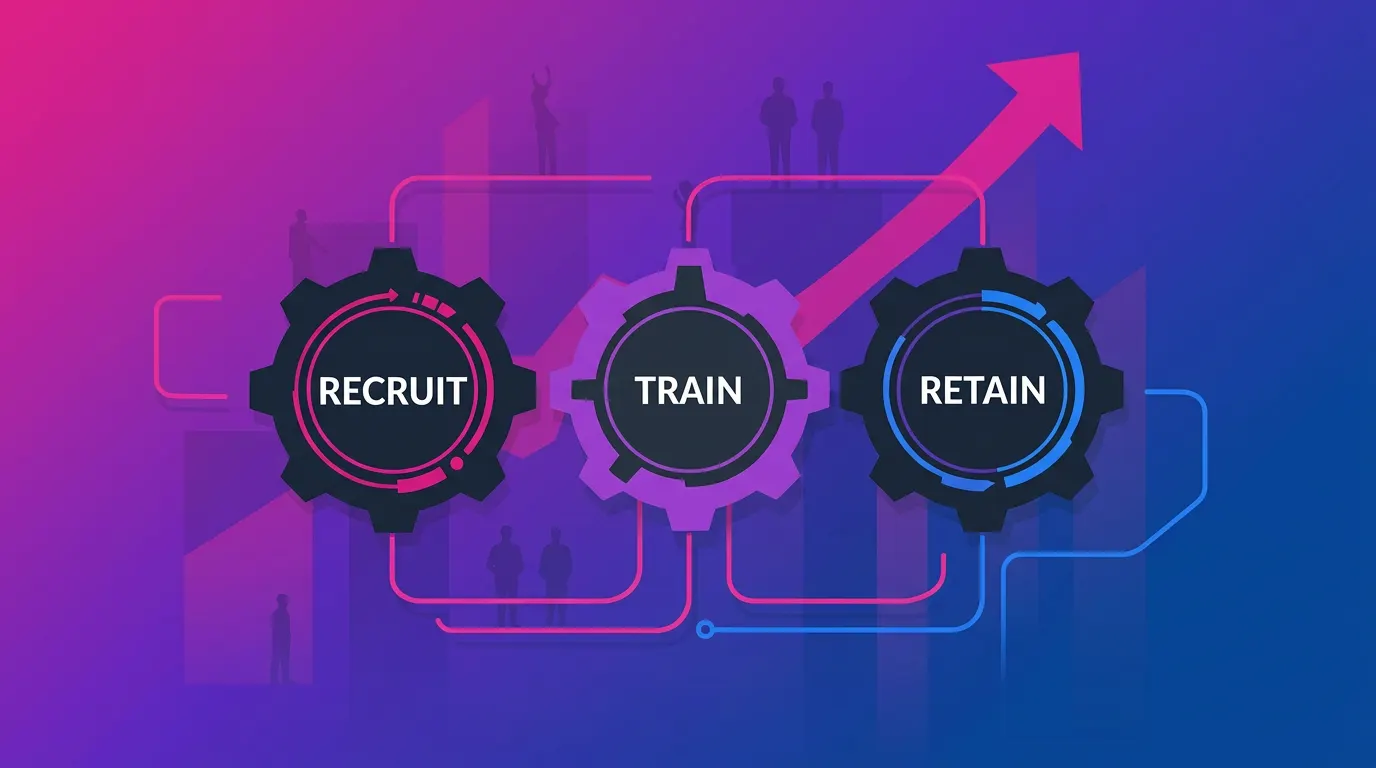
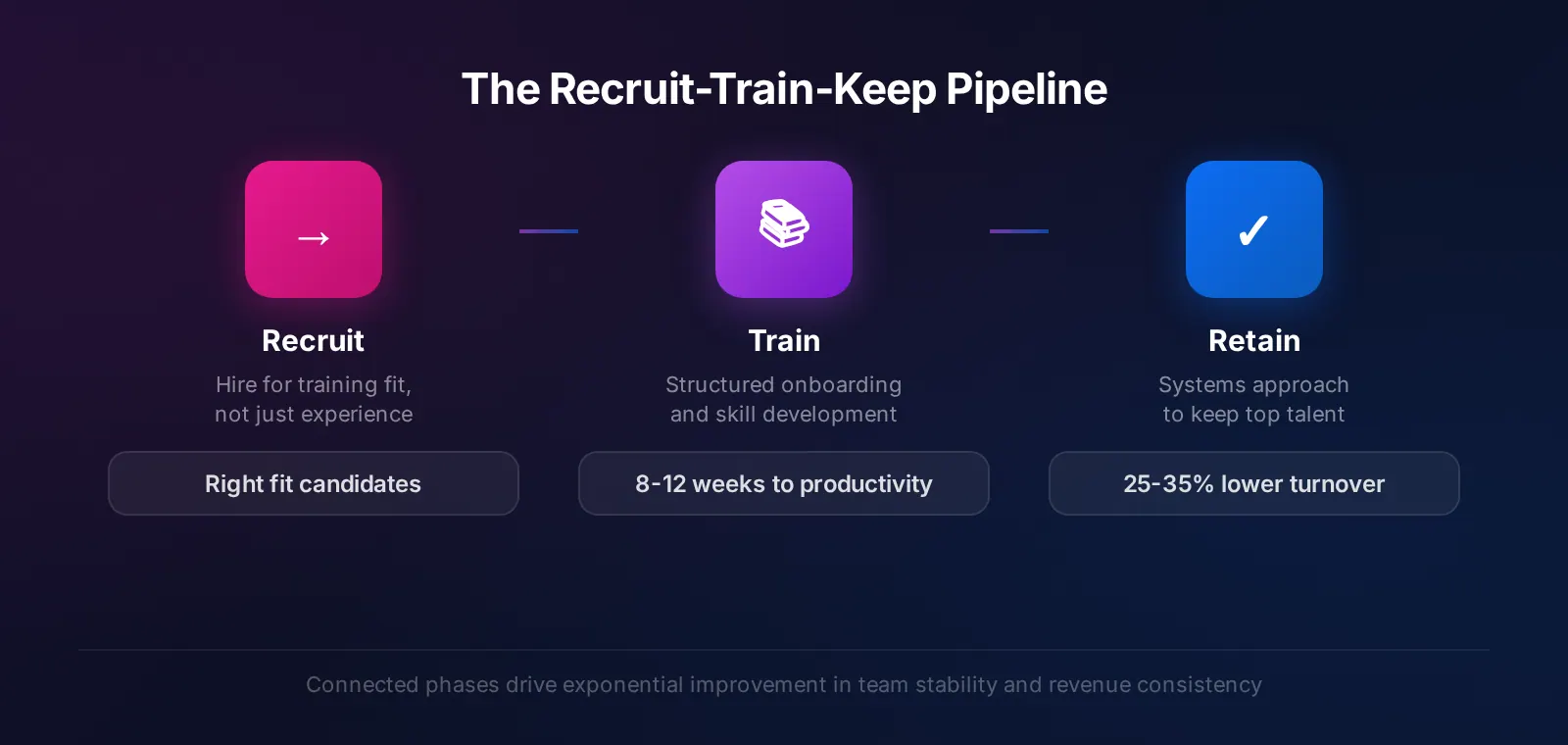
Recruiting, training, and keeping field sales reps aren't three separate problems. They're one system. Companies that connect these three see 25-35% lower turnover and reps reaching quota up to 50% faster.
TL;DR
Recruiting, training, and keeping field sales reps aren't three separate problems. They're one system. Most home services companies fix recruiting by posting on Indeed, then wonder why reps quit after three months and take months to get productive. A systems approach tackles all three simultaneously: align hiring criteria to your actual training process, embed retention strategies into day-one onboarding, and use data to spot turnover risks before they happen. Companies that connect these three see 25-35% lower turnover and reps reaching quota up to 50% faster.
Why Does Treating Recruiting, Training, and Retention as Three Separate Problems Cost So Much?
Because fixing one without the others just moves the failure point. You recruit better candidates but throw them into broken training. You improve training but ignore the retention signals. A systems approach tackles all three simultaneously, and companies that do it see 25-35% lower turnover and reps reaching quota up to 50% faster.
You post a job on Indeed hoping to find reps. You hire whoever has door-to-door experience. You throw them at your training process. Three months in, they realize the job isn't what they expected. They're burned out, compensation was unclear, or management never checked in. They quit. You repeat the cycle.
This disconnect costs you. Replacing a single sales rep costs $115,000 when you factor in separation, recruitment, training, and lost productivity. A 20-person team with 25% turnover burns $575,000 a year on replacement costs alone.
But there's a structural fix. When you design hiring criteria based on what your training process actually teaches, and when you build retention checks into your first 30 days, turnover drops and productivity skyrockets.
Here's how: A company that knows their reps take 8-12 weeks to reach baseline productivity won't hire hustlers who need constant external validation. They'll hire resilient learners who can sit with discomfort during the ramp period. They'll pair them with mentors who check in daily. They'll use performance data to catch burnout signals early.
The companies winning in 2026 don't solve recruiting, then training, then retention. They solve all three at once.
Why Do Most Home Services Recruiting Efforts Fail?
Most recruiting fails because companies hire for experience instead of fit. They find candidates fast but lose them faster. Sales rep turnover averages 35%, nearly three times higher than other industries. The fix is hiring for attitude, defining success before posting the job, and sourcing from multiple channels.
Sales rep turnover averages 35%, nearly three times higher than other industries. In home services specifically, turnover often hits 20-25% or higher. You can keep hiring, but if you're bringing in people who don't fit your system, you're just cycling bodies through the door.
Most recruiting fails because companies hire for the wrong attributes. They look for someone who "has D2D experience" and assumes that experience transfers. It doesn't. A rep who succeeded in solar might fail in roofing. Someone who thrived at one company might hate your culture, your compensation model, or your territory sizes.
The second failure point is speed over fit. You post an ad, you get 30 applications, you interview two, and you hire the first one who says yes. Desperation hiring backfires. That rep quits week two because they weren't actually committed.
Here's what works instead:
Interview for attitude, not just experience. Ask scenario-based questions: "A homeowner slams the door in your face. What do you do next?" Their answer tells you whether they're resilient or fragile. Someone who interprets rejection personally will burn out fast. Someone who shrugs and moves to the next door will survive.
Define what success looks like before you hire. If your reps average 50 doors knocked per day, don't hire someone who's used to knocking 20. The culture clash will sink them. If you require 6 months before commission kicks in, hire people who can stomach that. Be explicit in job postings.
Hire cohorts, not individuals. Bringing in three reps at once creates peer accountability and faster bonding. Solo hires feel isolated and often quit because they have no team. Cohorts also let you run structured training instead of one-off onboarding.
Source from multiple channels. Don't lean entirely on Indeed. Use LinkedIn, local job boards, referral bonuses from your existing reps, and community networks. Top-performing reps often come from referrals because they're already pre-vetted by someone you trust.
How Much Does It Really Cost to Lose a Field Sales Rep?
Replacing a single sales rep costs $115,000 when you factor in separation, recruitment, training, and lost productivity. A 20-person team with 25% turnover burns $575,000 a year on replacement costs alone. Most companies undercount this because they only measure the recruiting line item, not the downstream damage.
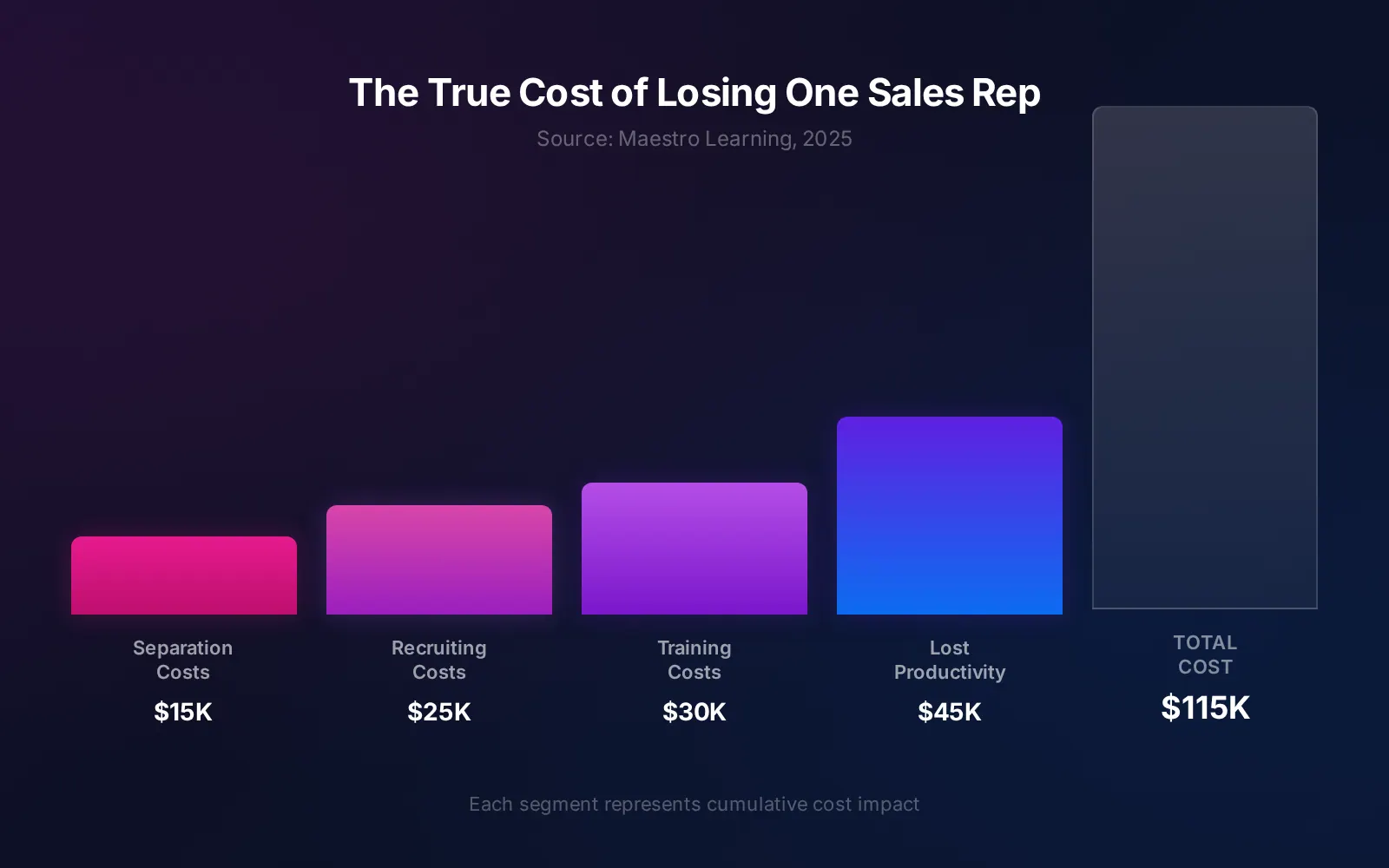
Here's what a single rep departure costs:
Recruitment and hiring: Recruiting a single technician or sales rep costs $5,000 to $15,000 in advertising, screening, and interviewing. Once you find them, especially if they're senior or specialized, the total cost can reach 100-150% of their annual salary.
Onboarding and training: It takes 8-12 weeks for a replacement rep to reach baseline productivity. During those weeks, you're paying for materials, manager time, shadowing hours, and the mistakes they make while learning. You get partial value for full pay.
Lost productivity and revenue: Your effective revenue per job can drop by 20-30% while the vacancy is filled and the new hire ramps up. Your remaining reps stretch thin. Your sales manager spends 5-10 hours per week onboarding instead of coaching.
Diminished customer satisfaction: Turnover disrupts service quality. Customers feel the transition. In home services, where trust drives repeat business, losing one technician often means losing the segment of customers they used to serve.
Team morale erosion: High turnover creates a self-reinforcing cycle. Remaining reps feel overburdened. Burnout increases. More people leave. Knowledge walks out the door with each departing rep.
Put it together: HVAC businesses can lose up to $4 million a year to turnover once all costs are tallied, including lost productivity and missed revenue opportunities. For a 20-rep team, that's $200,000 in hidden costs per person who quits.
The fix isn't hiring better. It's designing a system where good people want to stay.
What Does Effective D2D Sales Training Actually Look Like?
Effective training follows a 4-week structured ramp: foundation (week 1), process (days 4-7), tools and shadowing (week 2), role-play (week 3), then live calls with coaching (week 4+). Companies using continuous training beyond the initial ramp see 50% higher net sales per employee. The key is that training never stops after onboarding.
A 2-day product training followed by "go knock some doors" doesn't work. Here's what actually accelerates productivity:
Week 1: Foundation. Pre-arrival, set up system access, assign a mentor. Day one, cover mission and values (so reps understand why they're doing this, not just the mechanics). Product training, ICP definition, compliance rules. Reps should know what they're selling and who they're selling to before they hear a live pitch.
Days 4-7: Process. Walk through your sales process from door approach to close. Show them your scripts and talk tracks (not rigid, but structured). Teach objection handling. Explain qualification criteria. This is where they learn the rhythm of your business.
Week 2: Tools and shadowing. Train on your CRM, dialer, reporting dashboards. Have them shadow your top performer. Take notes on what works. Debrief after each call.
Week 3: Role-play. Mock calls where they play seller and you (or a peer) play buyer. Give feedback. Let them stumble in a safe space.
Week 4+: Live calls with coaching. They take real calls while a manager listens in. You provide feedback after each one. They increase independence as confidence builds.
But here's the critical part: This doesn't stop after 30 days. Companies that see 50% higher net sales per employee use continuous training. Weekly role-plays. Monthly coaching sessions. Recorded call reviews. Top performers sharing what's working with the team.
The difference between a rep who quits in month two and one who stays two years isn't better hiring. It's ongoing investment in their growth.
Why Do Good Reps Quit, and How Do Systems Stop It?
Good reps quit because of unclear expectations, isolation, compensation confusion, no visible progress, or burnout. It's rarely about money. Companies that replace annual reviews with ongoing feedback see up to 44% higher retention. The fix is structural: weekly coaching, public recognition, transparent comp, and clear career paths built into day one.
When a rep quits, the reason usually fits into one of these buckets:
Unclear expectations. Employees who see clear paths to advancement show 34% lower turnover intent. But most sales teams don't define what "great" looks like. Reps guess. They get frustrated. They leave.
Isolation. Reps who work solo without peer contact or manager check-ins feel abandoned. They interpret silence as disinterest. Regular communication (even just a weekly one-on-one) changes this.
Compensation confusion. If a rep doesn't understand when they'll get paid or how compensation connects to their effort, they'll find a job that's clearer.
No visible progress. Reps who receive meaningful feedback at least weekly are 4x more likely to be engaged. Without feedback, new reps can't see if they're improving. They assume they're failing and quit.
Burnout. Fifty to seventy doors knocked per day is exhausting. Reps burn out when they only hear "no" without visible movement on the board.
Here's what stops it:
Pay for performance. Link compensation to measurable outcomes like customer reviews or job completion rates. When reps see a direct link between effort and earnings, motivation stays high.
Weekly feedback, not annual reviews. Companies that replace annual reviews with ongoing feedback see up to 44% higher retention. Use real-time data to coach in the moment. "That objection handling killed it. Here's what you said that worked." They feel seen.
Public recognition. 71% of employees said they'd be less likely to leave if recognized more frequently. Celebrate wins early and often. Leaderboards, shout-outs in team meetings, bonus opportunities for closing streaks. Make excellence visible.
Clear career paths. Show reps how they move from new hire to senior closer to team lead to manager. Remove the ambiguity.
Manager check-ins. A 15-minute weekly one-on-one where you ask "How are you feeling?" catches burnout before it becomes a resignation.
These aren't expensive. They're structural. They fit into the recruit-train-keep system.
How Do You Build a Recruit-Train-Keep System?
Start with five steps: define your ideal rep profile based on traits (not just experience), align hiring criteria to your actual training process, build retention signals into day-one onboarding, use performance data to spot risk early, and communicate what success looks like in writing. Here's the breakdown.
Step 1: Define Your Rep Profile
What does your top performer look like? Not years of experience. What actual traits do they have? Resilience? Curiosity? Coachability? Write this down. Use it to screen candidates.
Interview at least five people per open role. Ask the same scenario questions to each. Rate their answers on a consistent rubric. Hire the person who scored highest, not the first one who said yes.
Step 2: Align Your Hiring to Your Training
If your training takes 12 weeks to ramp, don't hire people who need constant external validation. They'll quit in week three. Hire people who can sit with discomfort while learning.
If your territories are sparse and reps need to solve problems independently, don't hire someone who needs hand-holding. Hire someone who figures things out.
Make your job posting honest about what the first three months feel like. Frame it as an investment period. "You'll knock 50 doors a day, get maybe 2-3 conversations, and close 0-1 deals per week while learning. By month four, you'll start hitting quota." Candidates who see that and still apply are more likely to stick.
Step 3: Build Retention Into Day One
Assign a mentor before they start. Have their workspace set up. Welcome them like they're part of the team already.
First day should feel like "You're here. We're excited. Here's the map." Not overwhelming, but intentional.
Daily check-ins for the first two weeks. Not reviews. Just "How are you feeling? Anything confusing? What questions do you have?" This signals that management cares about their integration.
Step 4: Use Data to Spot Risk Early
Track performance metrics: doors knocked, conversations held, conversion rate. Compare each new rep to your historical average for their stage.
If a rep's contact rate drops 30% in week 4, something's wrong. Maybe their territory is saturated. Maybe they're demoralized. Don't wait until they quit. Talk to them.
If someone hits quota in month 3 but hasn't received a manager check-in in two weeks, you're about to lose them because they don't feel valued. Reconnect.
Step 5: Communicate What Success Looks Like
Every rep should know:
- What their target doors-per-day are
- What a good contact rate looks like for their stage
- What commission kicks in and when
- How they move up (to better territory, team lead, management)
- Who their mentor is and how often they'll talk
- What tools they use to track their work
- What happens if they miss targets (coaching, not fear)
Write this down. Share it in writing, verbally, and on your walls.
What Technology Connects Recruiting, Training, and Retention?
A Sales Operating System that integrates recruiting pipelines, training progress tracking, and real-time field performance data into one platform. You need visibility into three things: field activity (where reps are and what they're doing), performance metrics (doors, contacts, conversions), and onboarding progress (are new hires following the training schedule).
You need visibility into three things:
Field activity. Where are your reps? How many doors are they knocking? Are they following their route plan? Real-time location data and activity logging tell you if someone's struggling (and needs coaching) versus underperforming (and might need a harder conversation).
Performance metrics. Doors knocked, contacts made, conversion rate, revenue per rep. Track these weekly. When trends appear, you can coach before problems become departures.
Onboarding progress. Are new hires following the training schedule? Have they shadowed your top performer yet? Did they pass the compliance quiz? A simple checklist prevents training from falling through cracks.
The best platforms (like RepCard) integrate recruiting, training, and field execution into one operating system. You can see that a new rep is day 14 of onboarding, they've knocked 450 doors, they're at 22% contact rate (good for their stage), and they haven't closed a deal yet, so you know they need objection-handling coaching, not criticism.
Without this visibility, you're flying blind. You only find out someone's about to quit when they do.
The Recruit-Train-Keep System Works Because It Addresses Root Cause
Most home services companies throw money at the symptom (high turnover) without fixing the cause (a broken system). They hire more reps to cover attrition. They run training bootcamps that stress people out. They wonder why nobody stays.
The companies winning in 2026 have stopped doing this. They've connected the dots:
- Hire people you can actually train (based on attitude, not just experience)
- Train them with structure, mentorship, and ongoing coaching
- Keep them with visibility, recognition, and clear paths forward
When you do this, turnover drops from 25-35% to 10-15%. Your reps ramp 30-50% faster. Revenue per rep climbs because experienced reps are more productive.
RepCard handles all three pieces in one platform, from recruiting pipeline management to field activity tracking to performance coaching. You can see exactly which reps are tracking toward retention (high engagement, clear progress) and which ones are at risk (declining activity, low connection to team). Then you intervene before they're gone.
Ready to build your recruit-train-keep system? Book a demo to see how RepCard connects recruiting, onboarding, and rep development into one operating system that actually works.
Key Takeaways
- 1Recruiting, training, and retention are one system, not three separate problems.
- 2Replacing a single sales rep costs $115,000 when you factor in all downstream costs.
- 3Companies using a systems approach see 25-35% lower turnover and reps reaching quota up to 50% faster.
- 4Effective training follows a 4-week structured ramp and never stops after onboarding.
- 5Weekly feedback, public recognition, and clear career paths are the structural fixes that keep good reps.
Frequently Asked Questions
It typically takes 5.8 to 7.8 months to replace a rep and get them fully productive. Companies with structured onboarding and continuous coaching can cut this by 30-50%.
Usually it's not money. Peer turnover and feeling unsupported by management are the top reasons. Stay connected to your team.
Both. Best mix is 60% experienced, 40% junior. The experienced ones can mentor the new hires while the new hires bring energy and flexibility.
Watch three signals: A sudden drop in activity (doors knocked per day), declining mood in team meetings, or withdrawal from the team.
Transparent, performance-linked compensation works best. A mix of base salary plus tiered commission works better than commission-only. Most successful home services teams use $3,000-$4,000 base + 6-10% commission.
At minimum, weekly for new hires. Monthly for established reps. Frequent, light coaching beats annual review ambushes.
Yes. Companies that invest in sales coaching, clear career paths, and regular feedback see retention improvements of 25-34%. The key is treating all three as one system.
Related RepCard Features
Related Articles

Recruit, Ramp, Retain: The Playbook
Master the three R's of sales team building. Learn proven strategies to recruit top talent, ramp them quickly, and retain your best performers.
Read more
How to Recruit Door-to-Door Sales Reps
Recruiting door-to-door sales reps requires a system, not a job post. Learn how to build a recruiting pipeline that sources, qualifies, and closes candidates before your competitors do.
Read more
How to Reduce Door-to-Door Sales Rep Turnover
D2D sales rep turnover is one of the biggest margin killers in home services. Learn the specific levers you can pull to cut your turnover rate and keep the reps worth keeping.
Read more