Episode #2
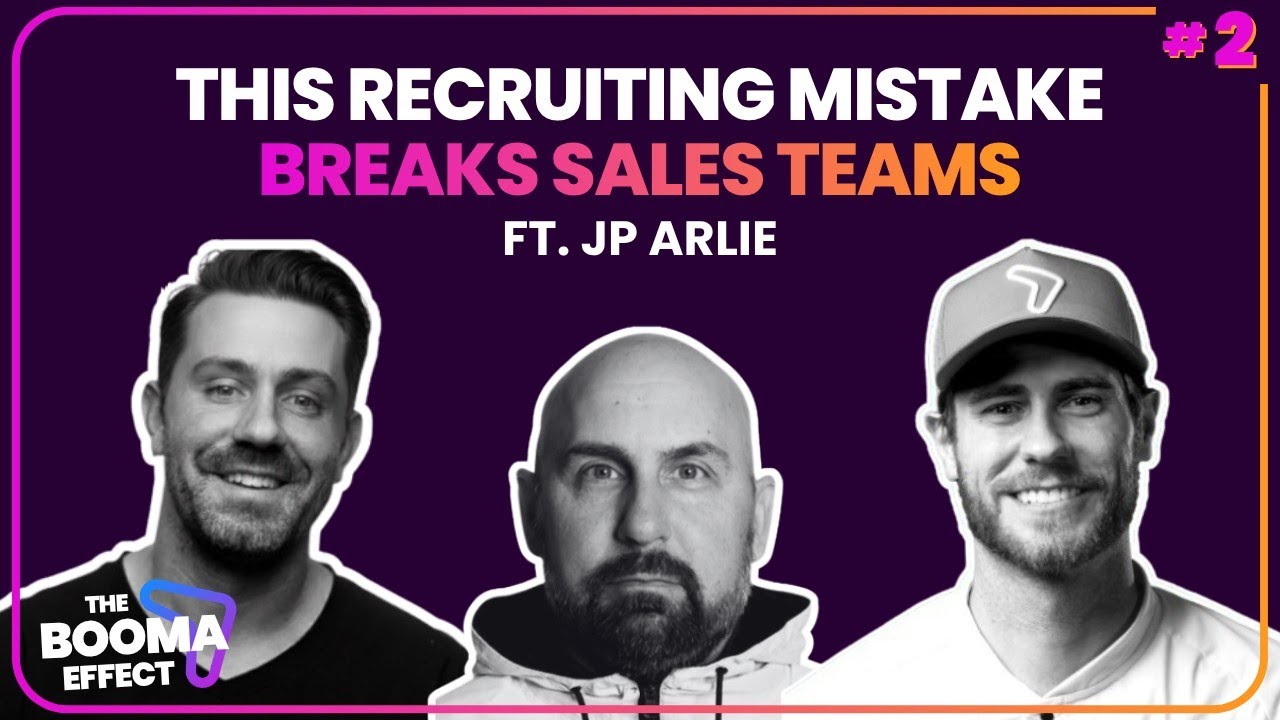
The Recruiting Mistake That Breaks Sales Teams: JP Arlie
May 22, 2026 · 49 min

The Booma Effect · Episode 2
JP Arlie | The Recruiting Mistake That Breaks Sales Teams
About this episode
Vivint Smart Home sent flowers to JP Arlie's wife every two weeks for six months until he left a great job in sunny Southern California and moved his family to Utah. He then helped Vivint scale by opening 20 brick-and-mortar recruiting offices outside Salt Lake, pulled 2,000 reps into the pipeline in 14 weeks, and trained 30 of Vivint's top managers in a single master class. 30 years in direct sales. Cutco. Vivint. Harvard Business School executive coach. Today he runs The Talent Engine at recruittrainandretain.com.
In Episode 2, JP joins Brad Mortensen (CEO, RepCard) and Jess Reagan (CRO, RepCard) and calls out the biggest mistake home services companies make when they try to scale: they promote top closers into leadership and watch the team fall apart 90 days later.
If you're a founder, sales leader, or field sales operator trying to build a team that actually stays, this episode is the blueprint.
WHAT YOU'LL LEARN:
- The 6-month "flowers in the kitchen" recruiting sequence Vivint ran to pull JP out of California
- Why 9 out of 10 top closers will tank your culture in a leadership role
- The "Caleb Rainey" rule: how a 12-account rookie became a better leader than 100-account vets
- JP's recruit → train → retain → develop → repeat loop (and where most companies break the chain)
- The 3-scenario pre-frame that stops Day-14 quits before they happen
- Why "T-I-M-E is how I spell love" is the only retention strategy that actually scales
- The Michael Jordan recruiting move that closes candidates before they meet your competitor
- Why how you treat people on exit decides who fills your pipeline 10 years from now
CONNECT WITH JP ARLIE: 🌐 The Talent Engine: recruittrainandretain.com
WHAT IS REPCARD? RepCard is the platform home services companies use to build real relationships with customers. Digital business cards, reputation management, and the tools your field team needs to win the second sale.
🔗 Try RepCard: https://repcard.com
📲 Brad Mortensen: https://www.linkedin.com/in/bradley-mortensen/
📲 Jess Reagan: https://www.linkedin.com/in/jess-reagan-9807a6b/
ABOUT THE BOOMA EFFECT: The Booma Effect is a podcast for home services operators, founders, and sales leaders who believe the most profitable way to build a business is also the most ethical way. New episodes weekly.
KEYWORDS: Sales recruiting, sales leadership, building a sales team, home services management, door to door management, D2D recruiting, Vivint Smart Home, Cutco, field sales recruiting, sales rep retention, training sales reps, promoting from within, RepCard, JP Arlie, Brad Mortensen, Jess Reagan
#salesleadership #homeservices #salesrecruiting
Stay in The Loop for free!
Like this content and want more of it? Subscribe to our newsletter. 1x per month. No fluff, just the sauce.
Join 100,000+ sales professionals
Jess Reagan: What is up everybody wanted to welcome you to the boom effect podcast. This is our first episode where we have a guest and of course we brought the best of the best to make sure that we're kicking this off with a bang. So we have JP Arley joining us today. JP if you probably already know, but JP has been in the industry for 30 years in in-home direct sales. He's an executive coach at Harvard Business School. has influenced thousands of salespeople over his career ⁓ I would say probably hundreds of millions of revenue, if in the billions. ⁓ And we're excited to have you here ⁓ as of our community ⁓ and share your wisdom and your knowledge. And so we welcome you. Thank you for joining us.
JP Arlie: Hey, love to be here. Super stoked to ⁓ connect with you guys. texted just when I saw this pickup and I was like, dude, what a pickup, right? So you guys working together, it's gonna be awesome.
Jess Reagan: Yeah, the dynamic duo. is a long time ⁓ the waiting. Brad and I have been friends for a while and I used to promote Repcard and try to get it into the other businesses that I was involved with. It's been a pleasure. This is a great team to be a part Now you're in Utah, ⁓ North South, right? ⁓
JP Arlie: I am, yes. ⁓ I live in Highland, which is, ⁓ know, when I moved here I thought it was gonna be pretty diverse since I wasn't in Salt Lake or Provo, but you know, moved to the mothership, it's great.
Jess Reagan: Yeah, that's such a good spot. Are you from Utah originally?
JP Arlie: Born and raised in California, met my wife in LA and never thought we we would leave sunny Southern California. Had a great job, great home, great family, and those connections in the world that, that put me in contact with right after Vivint Smart Home was acquired by Blackstone. One of my former sales reps, ⁓ know, randomly we connected over a birthday wish on social media. We started picking each other brains about different things and next thing you know, I was on a flight. to Utah sitting with Todd Peterson and ⁓ They flew me out like every month for like six months until I said yes But yeah, then part of them and then about a year later They asked me to move to Utah and we didn't hesitate we jumped on it was time to get out of California
Jess Reagan: Yeah, that is pretty good timing, all things considered, ⁓
JP Arlie: 2016 into Utah was great timing.
Jess Reagan: I was gonna say so yeah, 2016 my my first experience I think it was a vivid kickoff and I believe you were teaching about recruiting. And I just remember I remember going into the room and hearing a lot of people say like kind of on this with the whispers of like, dude, this guy's a legend. He's awesome. You know, like, if you want to learn about recruiting, you know, this is your guy. So like love to start at the beginning like 30 years, this space.
Brad Mortensen: to hear about those six meetings if we could start there, if that's fine with both of you.
Jess Reagan: Yeah, absolutely.
Brad Mortensen: I want to hear how they recruited you what did you pick up on being a recruiter and being recruited? It's kind of like, Oh, I saw it coming from a mile away. Like what tactics or what, like, what, what good was that? Like how, how did that, how did they court you and how did that happen? Cause yeah, like you said, you're in sunny Southern California home family where you grew up. Like that's, that's hard to pull anybody away from home. And I would love to hear, you know, Todd, you're talking some of the best. What's their only.
JP Arlie: Yeah. So, know, one of the, you know, talking about recruiting, one of the things that I think is a hidden when you find people that are naive, right? And was really naive in college being recruited into direct sales coming from a very small town in Northern California that I wasn't jaded. didn't have any blind, I didn't have any, you know, I had blinders on. And so
Brad Mortensen: that.
JP Arlie: When I reached out, I'm going shout out Trevor Maddox, if you know Trevor Maddox from the space. Trevor's the guy, right? Trevor sold Cutco for me when he was in college before his mission. And he reached out, wished me a happy birthday. I saw a bunch of stuff he was doing online. And so I was just picking his brain to find out what this company was and what they were doing. The tech was cool. And I was just trying to extract value for my own situation. I wasn't looking to really leave. At the same time, there was some struggles in Cutco business model that ⁓ were ⁓ with. And so when Trevor said, hey, you wanna come to Utah? I said, I would love to check it out. We did the innovation tour, we did the installer facility tour, and then, hey, I set up a meeting for you. So I met with Jeff Mendez, and then he's like, I got another meeting for you. Nick's saying, you I'm gonna sit in Todd's office. ⁓ the unique about that, obviously, I've... grew to totally respect Todd and find out who he was. But at the time, we're just two 40-year-old men with back problems complaining about our morning workout and our kids and our wives. we were just shooting the shit. And he was telling me everything that was going on. And I remember at ⁓ the I asked him a question that I don't think I'd ever have the courage to ask him again. But at that point, I was realizing they were recruiting me. And he was talking about these meetings at ⁓ Blackstone he was going to. And I've come to learn that Todd ⁓ really kind of downplayed his intelligence to a point that brings people in. But he made me ask him the question, like, well Todd, you are in these meetings, how do I know that you're the CEO that's gonna take this to the next level, right? And he had a fantastic answer, he's like, I don't know if I'm not, but when I come back from these meetings, I stay up all night learning and trying to learn everything I didn't understand to become better. And that to me was the first time where I realized how truly, talented he was, it was, I was pretty naive in that process and I remember Trevor was giving me a ride back to the airport, by the way, his baby was born that day, on the way to the hospital to meet his wife's first newborn. And the phone rang and Trevor got off, know, chatted, chatted, chatted and hung up and he's like, well, what do you want? I'm like, what do mean? Like, as unbeknownst to these recruiting tactics of Utah, was like, what do mean, what do you mean, what do I want? He's like, what's the dollar amount? I was like, what?
Jess Reagan: Yeah.
JP Arlie: Like I was so confused, I'm like, well, I mean, I think I just want a job. Like didn't know what I was even asking for negotiating with and it wasn't really on my mind. And then get home and there's flowers on my kitchen counter from Vivint ⁓ ⁓ send them to my wife as a thank you. And then every couple of weeks I'd fly out and every couple of weeks there'd be flowers. And finally I just called and said, stop sending flowers. You're making me look bad, right? Like every I leave town, you send flowers to my wife. ⁓ It's a long answer to your question, Brad, but I think what eventually just kind of happened is I saw the culture and these super talented individuals with no systems or structures, no symmetry, no coordination. was all regionalized and compartmentalized and nobody was sharing information. I just thought that's so easy to fix. So easy to fix. And so that's kind of what got me interested. ultimately I just kept on, I think that first fly out was in like September and I didn't really commit until January. whatever I guess it was a little less six months.
Brad Mortensen: Yeah. So, so were attracted to just like their authenticity and opportunity you know, kind of of organization to some degree, ⁓ but, also just like, like said, Todd, like he could have answered that question and been like, ⁓ I'm the biggest hustler out there and blah, blah. But he was just like, dude, I don't know, but I basically I'm willing to learn anything and I'm willing to put in the time. ⁓
JP Arlie: Yeah.
Brad Mortensen: And so it sounds like as you met with those different people, much as they were recruiting you, it was also them just uncovering like who they were ⁓ And you were like, cool, like this feels right. And almost sold yourself on it. ⁓
JP Arlie: Yeah, I I don't think I was, I wasn't being recruited. I was almost recruiting them. was almost, if I'm going to leave this great opportunity where, you know, at that time I was like 21 years, you know, leading an organization, high reputation, you know, I wish I still had my pool, right? I don't have my pool here in Utah. You know, the one was in all plows is for sale, the pools when we moved here, but that's about the only thing I miss. I kept on finding, I remember I watched every single video I could find on Insider. Everything. I wanted to know the language, I wanted to understand the product, I wanted to understand the content. And so I just absorbed everything. And one of the best things I saw, by the way, shout out to the Williams Brothers, their training manual was like extremely well written for back in 2016. Like it was incredible. I'm like, this is great, but nobody's using it. And so I eventually just...
Jess Reagan: Yeah.
JP Arlie: fought myself into an opportunity. And then what we did, what we ended up doing was 20 brick and mortar locations outside of Utah to recruit. Because Utah was, ⁓ you guys know, hey, I'll give you a dollar to come work for me. I'll give you $3, but they work for the same company. So you're literally negotiating against your own bottom line. You're making the accounts more expensive and tied to your own company. And so by ⁓ 20 brick and mortar locations outside of Utah,
Jess Reagan: Yeah.
JP Arlie: they were able to, when you tell somebody they make $10,000 in the summer, that's a scam. You do that in Utah, they're like, nah, what? No, my bro made 100. It's different. So we did that extremely successfully. I think we recruited 2,000 people in 12 and a half or 14 weeks or something, which to us, we failed. And to them, we were like, wow, right? And we're like, yeah, we could have done better.
Jess Reagan: you So a lot of, so you're actually into an issue that a lot of companies have, which is expansion, especially recruiting. Cause it's like, where do we find them? Right? Like that's number one is where do we source recruits, which I think you and I probably know. And Brad knows like it's actually easier than people think to source recruits. The real problem is the conversion and then making sure that they actually ⁓ are, you adopting the business and sticking, right? Like they're retaining. So scaling to 20 brick and mortar offices, doing that successfully, somebody who has one regional hub and they're wanting to do something similar, some of hurdles that you faced in just expanding into that?
JP Arlie: Well, as you know, Jess, it's recruiting is not the issue. There's bodies like it's like there's always a door to knock. There's always a body to recruit. Like recruiting is the furthest problem from recruiting is the actual human that comes into the pipeline. The ⁓ make me laugh, ⁓ the biggest challenge we had in doing that was the red tape ⁓ a corporate location, you know, getting leases approved. That was like ⁓ ⁓ part. was plugging the system in place, right? Having the people who knew the system, like for somebody who's listening to this that isn't surrounded by people that know the systems of recruiting, the hardest thing would be finding people to scale through, training those people, which is why a lot of what I do now as leadership development programs is where they have a bunch of reps, they know how to sell, they know how to, we all know how to. recruit, we all know how to get people to go knock doors. We all know how to get people to do things that might get us in trouble if we got caught, right? Like we all know how to do that, but putting them in a system that retains them and then develops them and then teaches them how recruit and train other people, right? A leader's somebody who can develop leaders that develops other leaders. That's the challenge, right? So somebody who wants to scale outside of their own local hub, you really have to invest in somebody. I would say more than one person, cause I would never send somebody out. by themselves, that's a kiss of death. Sending one guy, if you guys are in Phoenix and you want to send somebody to Tucson, you send three people, right? You don't send one. One's gonna be lonely, one's gonna quit, and one's gonna burn your money on your building.
Jess Reagan: Yeah, and then would you say transitions, like how those people manage the transitions of the new recruits that are coming in? Because you said like, yeah, finding the bodies, you know, that's not necessarily the hard part. So the hard part is getting the trainers, it's getting the people to, you know, adopt processes. But what are those processes, right? Like, what are you seeing that works ⁓ super well ⁓ a, you 30,000? foot view.
JP Arlie: mean, really think biggest challenge is finding, most people go after their top sales reps and try to convert them into managers. But, how ⁓ many elite athletes elite There's a certain mindset of an individual contributor at the highest level that's not the greatest fit for leading and organizing a team. The DNA is different, ⁓ the personality assessment is different. Somebody who is a pipe hitter out front but is not somebody who thinks about people first, they're going to be very, very challenged in developing a team. So identifying the right personality type for a leader and it might be, tell you guys a story. ⁓ made my day yesterday. Um, so the last person I recruited in the, I don't know what summer it was. It doesn't matter. It was, I was in town. I was in Arizona, Brad. And, um, somebody's like, Hey, I got this guy at, at Grand Canyon college. They're leaving like four days later for the summer. It's like, will you come interview so I can watch his name is Caleb Rainey. And I'm like, sure. So I gave me Caleb. He's awesome. He's the head of the school ministry. He's social. He's active. And I'm like, basically, bro, you're leaving four days. You want to go, right? And he went and he sold like. 12 or 16 alarm accounts, than 20. The fact that he made it to the end of the summer, didn't quit, didn't get sent home is miracle number one. Well, I meet him when he comes back, ⁓ of ⁓ 40 some odd people we sent out of Arizona that summer, I meet with him first. And I say, you're my guy. I'm like, what are you talking about? I'm like, I don't need somebody to go sell 200 accounts. I need somebody who can run youth ministry for 50. I need somebody who's a bus driver that takes people from Grand Canyon. down into Tempe and gets him fired up, right? That year we ran an 80 person event at my house. He had 80 people at my house and he was running a mafia game in the center of the circle for 80 people. And he ran it like he was Tony Robbins on stage. He's that kind of recruiter. So he goes out, I think he recruits 10 or 12 people that second summer, doesn't sell great, ends up leaving. He texted me yesterday that he just bought the business that he's been running for the last six and a half years in Texas, right? Which is it basically, buying property cheap, fixing it up and selling it, and he just bought the business, right? And that's somebody, when I talk about what I wanna do in this world is to positively impact lives of others and change the course of history, that's the type of leader that you need is not how much they can sell, but how can they attract others to do it as well. So the biggest challenge I think companies have when they wanna scale is they pick the wrong people. They pick people based on sales volume, not based on personality traits. that's somebody, when I talk about what I wanna do in this world is to positively impact lives of others and change the course of history, that's the type of leader that you need is not how much they can sell, but ⁓ how can they attract others to do it as well. the biggest challenge I think companies when they wanna scale is they pick the wrong people. They pick people based on sales volume, not based on personality traits.
Brad Mortensen: Dang. ⁓ I wish I would have known 20 years ago, dude. ⁓ feel like I'm like learning or some of this. just like... So many times you almost feel obligated, right, give them the opportunity first, because they're the number one sales guy. I ⁓ was thinking back to my ⁓ of training and selling and teams, it like, well, I need to find somebody that everybody knows can sell, ⁓ because when they do the or when they, I'm forgetting it, you can compartmentalize this and have a trainer and have a recruiter or have different people. ⁓ people play different roles you feel like that one person has to do all of it. So ⁓ think that's freaking advice for anybody listening that's looking to scale team is you're allowed to go somebody ⁓ to be a leader your company that isn't a number one sales rep.
JP Arlie: people who have the DNA to be an amazing leader that also are top performer, they're looking to get out of top performing, right? They're looking to give back. Those people usually leave and go do something else if they don't have an opportunity to lead. And then you look at people who are medium performers that get passed over because other people were given the shot. they end up leaving somewhere And least the teams that I've seen that are the best ⁓ co-managed teams usually somebody that's the racehorse and then somebody that's making sure the troops are right? The person who's gonna call everybody at the end of the day and go, hey, how'd things go? The person who's willing to make less money ⁓ their personal overrides generally overall to help other people make more money.
Jess Reagan: Yeah.
JP Arlie: And then those are the people, right? If you've ever seen the movie The Town, where I'm like, hey Brad, I need to ask you a favor. And we're gonna go hurt some people and you never ask me about it again. He's like, whose car are we taking, right? That's how you develop those people is when you take your own time. T-I-M-E, it's how I spell love, and you give it to others. Those people are like, yeah, I'll stick around longer for this guy, even though I'm not making the kind of money I'd make elsewhere because there's something about them. and I wanna be close to them. And if you get enough of those people around you, mean, look at what you built at Repcard, right? Like the people that you have around you, you probably are nowhere near where you are right now if you didn't have people that looked out for you when you weren't. a team gets built.
Jess Reagan: also some level of ⁓ that has happened in our industry for not the top producer and for people who are really good office managers or good at operations. You see a salesperson, their skill set is definitely ⁓ operations and the office, making sure things run smoothly, maybe even finance or commissions, making sure that the onboarding goes well. ⁓ the reps are getting oriented the right way. There's incredible people to do that. And I think, used to be some shame around that type of person that was like, ⁓ dude, you know, like go do something else. Like you're, if you're not going to go out and produce and you're just going to be, you know, an office manager. Do you, do you see that there's like a shift in that or do you feel like by creating that shift companies are seeing better results?
JP Arlie: Well, I think you look at it like I look at, I look at the Navy, right? You have your Navy SEAL teams, right? SEAL team one through six or whatever. And those are individual high performers that can work in small teams that don't have the time to waste on mistakes. But it's not 87 man teams, right? They're six man boat crews. They're elite teams. But then you still have a Navy with thousands of people on a boat, right? And so are you trying to run this special ops? And if you are, then it's gonna be small and mighty and powerful and fun and you get to live that life. But if you're trying to build a community and build a region, a region isn't built of, just take the summer sales model, of five just amazing six-person teams. Right? It's just not. And you know, the analogy I was given when I was younger in the business was as a manager, imagine sleeping in your bed and you got one of those blankets that when you roll over, air gets underneath, right? But when you don't move, you're totally warm. Well, those are your top performers and everything that hangs off to the side of the bed and touches the floor. And when you roll over, you never feel a draft. That's everybody else. Right? And so, so you need everybody to stay warm.
Jess Reagan: You
JP Arlie: so you need everybody to produce large organizations and that's why people, ⁓ a book out there called E-Myth. don't know if either of you have read E-Myth. The premise of the, one of the ⁓ things I away from the book is just because you can make a good pie doesn't mean you should open a bakery. So just because you can sell lights out doesn't mean you should become a manager. Just because you can build a big team doesn't mean you should open a company, right? Like there's things that you just don't. don't know until you until you learn them. And ⁓ shaming, I think it's such ⁓ competitive, industry, or I would say ⁓ was competitive, hard industry. It's still hard that the only way you could survive was by promoting people in a manner so they can manage more teams. So it was almost shaming if you didn't take the role. And ⁓ yet not the best thing for the organization. How many un unhappy high performers where they're like dealing with people who just aren't them. Right? I sold eight today, you just baggled, right? I don't understand, right? Well, that's the problem. They never sold zero. What they did, they didn't do it very long.
Jess Reagan: Yeah. so the empathy, that's it. Yeah, then you're then you're dealing with somebody who lacks empathy for the team and you know, and that can get tricky as well. But you're right. Like, it's interesting that you said that it's actually there's also shaming when people don't take the role. So going around.
JP Arlie: I remember back in my cut co days, there was a gentleman that actually happened to me twice. People that trusted me at 17 and four years later, they're 20, 21, they're graduating college. They've made six figures. They got six figures in the bank as a college grad. I played a significant father figure in their life in capacities. And so they completely and utterly trusted me. And I got them to the finish line to take their manager promotion. And in both times, on stage, handing it to them, I looked in their eyes and I just knew there was only one reason they were doing this for me. And in both scenarios, I stepped off stage with them, I said, look, you don't need to do this. You just don't, right? And in both scenarios, they went other routes. ⁓ Both of them are extremely successful. I remember one time, threw some shade on me in social media and the wife of of them just got on there and just ⁓ annihilated poor human that decided to throw shade. Maybe I it, ⁓ but she's do you know who you're dealing with? This guy did this for my husband. You just have do right by people ⁓ always. And if unsure what they wanna do, and you are sure in your systems and your love for humans, then yes, I would 100 % push them to do things that I thought was best for them if they were unsure, because I know I care about them. the wrong people in this industry do things for selfish reasons and aren't looking past, right? Hey, that person's only making 80 grand a year, but they're making 80 grand a year and have missed a car payment in six years and they got their rent taken care of. and then you get them to leave that, next thing you know they're three months behind on their car payment and their wife is pissed off, like what did you just do there, right? You ruined somebody's life for your own, you weren't being selfish, but if you don't have the systems to back up your recruiting talking, like if you're just talking to Good Game and you don't have the systems to back it up, you're gonna put a lot of people in some uncomfortable situations.
Jess Reagan: Yeah, that's so true. That's that's one of the reasons why we when we talk about the the sauce or the sales operating system and we just did a rep card lab, right? Like where we had we had our customers show up and is it's so great to connect with them and to see you know what they're experiencing and what we could do better. Brad's always been good about that too. Just like, cool. That's awesome that you love this. Where do we suck? ⁓ You ⁓ and those questions.
JP Arlie: Saw that.
Jess Reagan: But the other part of it was just them come together to learn how to build out these operating systems because the culture reflects the systems and not the talent of the people that are there. And we often have this hero culture where you're just lifting this one person up. And so I always ask the question, what happens if the top 10 % of your ⁓ leaves? If your top 10 % sales reps leave, do those systems still exist? you know, does your company still exist? And we're actually seeing in a lot of industries that it doesn't, companies fail. And so from what you're saying is having a system to plug them into is the kindest thing that you can do, especially if you're pulling them away from an industry where 80 K might be frowned upon, but it's, the steadiness of it that serves people.
Brad Mortensen: JP, want to ask you a little bit about, know, when ran my teams, always would say like the best closers are the openers. And in like, you just kind like starts at the beginning, you know, you focus on the closing and the deals close, but like they're giving themselves more opportunities. How would you translate? that to the beginning of a new recruit, that system you're talking about. You recruit this guy, ADK, you pull him away from maybe comfortability and he wants more in life, but maybe, you and then you bring him into some system that's broken. What does a system look like that's not broken? Like, what are the things you recommend a company has in place to at least give the guy, you know, a little bit of a runway, a week, two weeks, 30 days. At some point, they've got to swim on their own. We can't be closing their deals for them, it's our responsibility as a recruiter ⁓ bring them into ⁓ into some type of system. Is any golden nuggets you ⁓ can ⁓
JP Arlie: They're all broken. They're all broken. mean, this is one of those, it's like the masterpiece. They're all broken in some way. My philosophy is recruit, train, retain, develop, repeat. just go through it. So you recruit somebody to start as a sales rep. Then you train them to be a sales rep. You develop them to become manager at the next level. But then you have to re-recruit them to be a manager. Then you have to retrain them to be a manager. Then you have to... ⁓ you know, retain them as a man, have to redevelop them. then they want to, like, so this is never ending cycle and it's always going to be, there's always a better way to do it. So, and that's the very hard thing for me, which is why it was so hard for me to eventually make the decision that I wanted to go out and just be on my own, is because my system was never perfected in my mind. But this conversation alone, you know, I can see it in your eyes, I can see when I talk to you, they're like, oh shit, like I didn't think about that. Like, I get it, right? And so to answer your question, is like selling. It's a skill that can be learned. And so you just have to understand the steps. And one is rapport. Step one is trust. Step one is believability. I think any given day, any one of recruits was looking for a reason to quit. A year in, two years in, three years in. They're still looking for a ha, I knew something was fishy. And same can be true as well where these recruits ⁓ years in should always think they could still be fired. ⁓ you get too comfortable with people and they think I can do whatever I want and there's no standards or no accountability, no I can't cross, the ⁓ same whose wife backed me one time,
Jess Reagan: You
Brad Mortensen: Yeah.
Jess Reagan: Mm-hmm.
JP Arlie: I remember I was like two years in with this individual and I would have people over at my house and bedtime for me, it was bedtime for me. I'm like, hey, you guys can hang out at the hot tub, do whatever. I'm going to bed, ⁓ I put earplugs in, whatever, so I couldn't hear them. Well, one time the same individual decided to climb into my water bed and like my significant right? And so, know, water bed moved, I rolled over, put my armor on, and I heard a chuckle and I'm like, get the F out of my bed.
Jess Reagan: .
JP Arlie: The next day came to my office, I sat him down, he thought he was gonna get fired. like, look, if we're gonna continue to work together, I have to feel safe around you. Do you feel safe around me? Okay, I need to feel safe around you that you're gonna protect me and my integrity and not put me in awkward situations and not me in a light that might look somewhere down on, like ⁓ what you trying to, like this kid was, he was so sorry, that's what training's about. I wasn't angry. But it was beneath the standard that I'm trying to create. So recruiting is about trust both ways. And I think at all times, I've promised this rep something and when I can't deliver, they're going to use it as a reason to say, you failed me, I quit, you didn't deliver on what you said. And most people might think, it, I'll recruit more. I'll recruit somebody else. growing up in a town with two stoplights, I knew everybody. If you cross somebody once, you can't get away from that. There's only so many people. And I don't know how many times in my career, I don't know, 50? Where I've had cousins or nephews or whoever, people reach out and go, hey, 17 years ago or eight years ago, my uncle, my brother, can I come work in your, yes, is the answer. It's because I did them right even on exit. And that's the thing that people don't, how they respond when people leave blows my mind. I had a gentleman. that this college student that worked for me, then he became a district manager, was doing well. He came to me in February of one year and said, hey, at the end of the year, I'm leaving. I'm gonna move to China. I'm gonna run my dad's special needs school. I'm like, awesome. And so the whole year we worked with his understanding that he was gonna leave. And the whole year we worked with his staff to make sure there was a replacement. He comes to me in October that year, he's like, I'm not leaving. I'm like, well, why? I didn't hit my goals. I'm like, what about your dad? He can wait. Okay, so the next year goes by and he finishes the fall and he breaks company records. Like the last month of the year, December, the biggest month he's ever had. Broke the all-time record. And he left out on an all-time high and nobody was, oh my God, he left. Everybody knew it was coming and I was there to supporting him and cheering him along.
Brad Mortensen: ⁓ snap.
JP Arlie: ⁓ Our organization didn't go backwards. He developed like six or seven replacements that were super high quality. In fact, this was like 15 years ago and one of his guys reached out to me yesterday on LinkedIn. you're not aware that they go home at night at the end of the day with you thinking about their dreams and their goals, if you don't know what their dreams or goals are, they're hiding them from you, then one day they're gonna drop a bomb. But if you're in a conversation with them, say, hey, Brad, I hope you're with me for the next 10 years and I hope you make a ton of money, but what do really want to do? If you go wave a magic wand five years from now, what do you really want to do? And then I do my best to get them there. And I have learned that helping more people exit and go off to do what they really want has served me more than avoiding what they really want.
Jess Reagan: you them on the way in ⁓ the same you love them on the way out, you know, and like you said, their goals. It's interesting ⁓ that in this industry, there's these family that exist. And where, you know, if you recruited somebody and you led them and you managed them and you gave them a great experience, there's like a handful of leaders in this industry that have this family tree. And when you belong to one of those and you say, you know, this person brought me in or I used to work for this person. And there's this honor and this respect that comes with it. And generally, I think it's because of what you're saying. Generally, it's because. They treated them on the way out the same way they treated them on the way in. And in a lot of cases, they tend to do business with them in the future. It might be different types of business, but you end up working together.
JP Arlie: Brad, you and I live in this baseball world right now and I'm sure have a relationship with your son very similar to having mine. talk so much differently than the parents other players that I see. people live vicariously through the of their children and the failure. And when they fail, they're like, what you doing? and they all upset thinking that the other parents or the other coaches or the other players are looking at them as parents thinking that their son striking out, you know, ⁓ 700 miles from home in a very expensive tournament is reflecting negatively ⁓ than as parent. I think the same thing happens in sales leadership as well. Right? When a rep fails, instead of the manager going, This is what I used to always say to piss people off. They're like, you know, Jess, what's going on with Brad? ⁓ this, that, the other thing. Well, are you not good enough to train him or is he not good enough to learn?
Jess Reagan: Yes.
JP Arlie: And I already know Brad's a stud, right? So, ⁓ gesture you gotta go, well crap, then I better get better at training them. And the same thing sports, as in training, is you take it personally when they fail, and then you don't know how to deal with it. And I learned a long time ago that if you succeed, it's your fault, and if you fail, it's mine. And if I accepted that, then it's okay. Then I'm not hurt when you fail. It's short memory. Yes, I'll move on. I'll recruit somebody else. And yes, I feel bad. But my intentions were so pure that I would do it over and over over over again.
Jess Reagan: you know, setting those expectations from the beginning to ⁓ is, something that shocks a lot people. Like I know that when I used to sit down with recruits coming in ⁓ and we would over the pay scale, right. And then I would say, here's what you make. You know, we've talked about this before recruiting process, blah, blah, blah. And then I would pull out my pay scale and I would say, this is what I make. This is what I earn off of each override. This is what I'll earn off of you and off of your production and off of your efforts. If you ever feel that I don't live up to this value, whatever that number was, come have a conversation with me. Like let's, let's talk about it. And I'm open to that. And, and I think once maybe in my whole career, did somebody come back and say, Hey, you're not earning, you're not earning your keep or whatever. And I think that authenticity and transparency that you're talking about JP, like that's, that's where it all begins and where people feel comfortable enough to hop in bed with you.
JP Arlie: So let's take that and take it to the recruiting side, because I used to love, like when I came into Utah and I learned this like absolute right, they're leaving talking to me to go talk to seven other companies. I'm like, ⁓ I never want to be first, I want to be last. But okay, if I'm first, I would say, hey look, ⁓ have seen Air with Michael Jordan story? Okay, where he's like, well, Mr. Jordan, let me tell you what's gonna happen.
Brad Mortensen: ⁓ yeah,
Jess Reagan: ⁓ yeah.
JP Arlie: You're gonna go to Converse and they're gonna do this. And then you're gonna go to Adidas and then you're gonna do this. And she's like, well, what are you gonna do? He's like, well, I'm gonna tell you your son's degree. Like, he had that down? Well, that's exactly how I recruit. I'm like, hey Jess, I don't have a problem. You're gonna go meet with everybody in this industry. All I want you to do is ask them for their training plan and their annual calendar. Because here's mine. Here's in the next 10 months of your life. And by the way, here's a digital link you can give to your wife.
Jess Reagan: Thank
JP Arlie: that will upload everything, and these dates won't change. They've invented, so you can plan around them. And then here is how we're going to train you, right? And here's your path of preparation. And now, I'm not gonna give it to you, but here it is, right? So when you go sit down with somebody, you say, hey, what's the calendar? They're not gonna have one. What's their path of the 10 things you need to do, right? Brad, your kid's gonna be recruited to go play baseball in college, right? Coaches are gonna come, and they're gonna show you their plan, their weight plan, their meal plan. They're gonna show you how they're gonna make it. They're gonna have a plan. If a guy just shows up with a big chew in his talking a good game, you're like, well, how you gonna develop? probably even for the high school conversation, right? Like if they don't have a plan, you're gonna go someplace that does. And so recruiting in this industry is the same way.
Brad Mortensen: Yeah, I mean, think you answered the question from earlier too. Like with that is like your when you bring somebody into your company or you're recruiting them is to provide them clarity. and tell me if I'm wrong, but I feel like that's kind of the nugget you just dropped was like clarity for them, not only for like the next day, week, but for the next 30 days, 60 days, at least like 90 days out, like, hey, here's how this is going to go. Then they have the ability to go and like execute on that or keep you accountable to that or have something to kind of work off of. ⁓ know I've been in offices and I've probably, ⁓ done this where you just recruit a body and then you're just like, ⁓ it creates this ⁓ of like, ⁓ shoot, somebody said yes. ⁓ I've got to go make a binder and I've got to go like all the stuff we did, you know, 20 years ago, it's like, got to now go do all this stuff. ⁓ I learned over time, ⁓ I know you did it at such a high level where it's like, that's I picked up from you is like creating clarity. And I hope people listening like big or small, ⁓ you create a 90 day plan, especially with AI and the resources you have now, ⁓ you create a 90 day plan ⁓ to to somebody upon them joining you and entrusting you with their family, especially if have kids and all the that come with They need to be out for a 90 day game plan to go to war with and to keep you accountable to. ⁓ I just, love that of dynamic ⁓ you talked about. One of the business advice we talk at Repcard, we get to talk to people from all industries and business owners or people that want to be a business owner, people that are leading a team and they want to go start their own thing. I always tell that are looking at partnerships, like when you start a new with somebody, like, talk about how you're going to end it. it's kind like what we talked about, like figure out a good game plan for how it's going to end. Cause the odds of you working with somebody for the rest of your life is zero. And so you have to see game plan of like, Hey, if this doesn't go well ⁓ and we're a million dollars in revenue or we're under this or whatever, kind of like your ⁓ key metrics we don't have more than 10 guys or whatever. ⁓ Cause one is going to say, well, dude, our company's worth 10 million. ⁓ And the guy's like, dude, ⁓ we've only ⁓
Jess Reagan: Dang it.
Brad Mortensen: Yeah, we have a cool logo and a hat now, but like everyone's always like miles apart. And so how can you create those scenarios where you treat people good on the way out and you don't burn bridges and you you've lived a life of just recycling relationships in a healthy way where people like their kids are coming back to you or they heard their cousin worked for you eight years ago and they're hitting you up on LinkedIn. And it's like, that's the kind of life you want to have after being in an industry for 10, 11, 12, 15, 30 years. like dude I've got I'm on my fifth phone number and just I hope know mommy tinted to Instagram account or whatever like it that does not a way to do it so
Jess Reagan: Thanks.
JP Arlie: So two things on clarity I think are important for the recruiting conversation and a package of in three. So if I'm recruiting Jess, I might say something, you know, we talk about the job, how much money you can make and we're like, Jess, I don't know how much money you're gonna make. Because I don't know what version of you I'm talking to right now. Because we all like to be recruited, we all like to puff our chests. But let me tell you this, we had 45 people work for us last summer in their first year. The top guy made 108,000, the last guy made like 87 bucks.
Brad Mortensen: That is so good.
JP Arlie: but the average person made 24,000. Now, here's the question I have for you. Think about the things that you really wanted to do. Sports, music, whatever your thing was, school. When you really wanted to do something and applied yourself, did you typically perform at a below average, average, or above average pace?
Brad Mortensen: above average.
JP Arlie: Above average, right? if my person made 24,000 bucks last summer, and you think you're better than most people when you apply yourself, then I think you have an idea. But if you show up and you don't put the work in, I'm sure you can think of something that you've done before. You didn't put your energy in and you probably didn't perform as well as you want. That's one of things I do when I bring them in. Then when I'm training them, when I'm finishing training, I'm trying to launch people into activity, trying to pull the slingshot back, I'd say something like, look, one of three things are gonna happen. ⁓ go out in ⁓ first two weeks, and going to do worse than you expected. Now Jess, based ⁓ on your ⁓ when struggled at things, do you typically quit or double down and go prove yourself? That's right. And then a second thing that could happen is you can go out and be ⁓
Jess Reagan: Double down, baby.
JP Arlie: average. Now, I don't know you very well, but if you were to go out in your first two weeks and you were average, would that motivate you to do better? Would that piss you off to the point of quitting?
Jess Reagan: Motivate me.
JP Arlie: Right, and the third scenario ⁓ go out and you dominate and you're the best person in your training class and you're the top, top new rookie in your first two weeks. Are you the type of person that's gonna go, that's good enough, or are you gonna look at the leaderboard and chase a vet?
Jess Reagan: Yeah, I'm chasing them. I'm catching them is, yeah.
JP Arlie: Chasing them. Right, okay? And that's exactly why I want to extend you an offer today. Because I'm looking for somebody that regardless of those three scenarios, you're gonna look for more. Now for whatever reason, you didn't give me the truth right there, you really think that you wouldn't, you need to check that your own. But now I've just set, ⁓ two weeks from now Jess comes to me and he's crying and wants to go home. I'm like, well why, I'm not doing very well. But you told me when I recruited you, and trained you that if this scenario happened, you would double down and fight. Right? I've already pre-framed the emotional fix, if that makes sense.
Brad Mortensen: Road, yeah.
Jess Reagan: Yeah, there, you know, something both of you are bringing up is like regarding clarity. I have some family members who are on the spectrum of autism and there's this saying in the autism world that clarity is kindness. I don't know if you guys have seen that, but if you were to think about like, you told somebody with autism, hey, it looks like the trash hasn't been taken out for a while. That means nothing. Right? Like that information means nothing because then they would say, you're right. It hasn't been. If you were to say, can you take out the trash? It hasn't been taken out for a while. You're showing that person kindness by giving them clarity in your instructions. And so since having some of these interactions, I've, I've personally really thought through my clarity of like, how am I delivering instructions to my kids? How am I delivering instructions to our coworkers or our teammates? if I'm doing it in a good way, even if it comes across as blunt, right? Like even if it's direct, that directness is kindness because over time it's truth, right? Like that is truth, it's not, no subtext, you where you stand. And so I've had to learn that over the course of my life because, you know, in the past I would deal with things with, you know, sarcasm and humor and... And you kind of like brush things under the rug and it's just going to be okay if we just look over here. And the clarity is key and all this is last thing I'll say we were on a team call yesterday. I think it was yesterday or they Yeah, yesterday, Monday. Yesterday. And Brad was leading this call and we were we were talking through a new release that we're coming out with ironically, which is recruit pro and we need to talk about this because it's just recruit tracking and
JP Arlie: Right?
Jess Reagan: whatever, it's not like done for you, but it's the tracker. And we're going through this and it, bugged out in the middle of the conversation, right? And asked one our developers, said, did you guys just push something? And ⁓ they, had, so there he kindly rebuked where he was kind of like, Hey, like we're on this call. We've got a lot of expensive people on here ⁓ and now not the time to push something. And the only reason I bring that up is because. ⁓ I saw that as like a kind correction in the moment that was not mean, but also got across the point. And then that person respects that, you know, that tutelage or whatever, and that clarity. so I don't know, I told my wife about that, Brad, because I was just like, this is just such a, it's like a powerful lesson in leadership that a lot of people miss.
JP Arlie: Have you always been that way, Brad?
Brad Mortensen: be honest, I probably wouldn't have said, I probably would have been ⁓ nice. ⁓ taught me ⁓ ⁓ difference of being nice and being kind. I think there's a big difference, and I would have been nice, Brad, which is and would avoid and have no clarity long term. ⁓ It would have got us through that moment without like a bump in the road or you want to call it. I think I, instead maybe somebody who would have blown up and like cussed him out and like has come I err on side of what's the word, like too passive. And I think that's just as bad sometimes as being the guy that cusses somebody out. And so I'm not trying sound like I'm like. good or great in that. It was something that I had to work on to be able to correct, but try to do it with a guide and with a purpose, and then just kind of move on and still treat the people like people.
JP Arlie: ⁓ you end up in middle. Either you're too hard to end up in the middle, or you're too soft to end up in the middle.
Brad Mortensen: So you up now? ⁓ It's 30 years in, you've got that wants. And knowing you, always up to something, ⁓ trying help serve, guide, change the world. What keeps fired? ⁓
JP Arlie: Yeah. So what I really, yeah, what I really wanna do is I wanna work with people that want to grow but also know where they are in their business. And one of the last things they did at Vivint Smart Home is I interviewed 80 sales managers and I chose 30 to do a master class. ⁓ and I put together a master class of, at the time, like the 30 up and coming Vivint managers. And it was an amazing, amazing experience. I've got to, I didn't get to finish, but I've seen these people grow. I watch them on social and I grow. that's when I was my happiest, ⁓ ⁓ I was excited to jump on ⁓ call with somebody. And so, my website is recruit, train, and retain.com. ⁓ And that's kind of my ⁓ for the last 30 years. And I'm slowly going to build a masterclass of high intent individuals that want to learn the entire ⁓ from recruit, train, retain. it's not, they're all interconnected, right? There's always that like, did Kobe blow his Achilles? Well, cause his knee was hurt, right? There's always like, there's reasons your body is breaking down. that are unrelated to what you think they are. And I think that's what happens in people's organizations. ⁓ probably three clients that I work with as a that I enjoy working with, that I'm keeping, and then I'll probably pick up one or two more, but then I'll just focus on those individuals that wanna jump into the masterclass. And it's a year-long process, and every month is a different topic, two calls a month, and then we go through the entire cycle of recruit, train, and retain, and repeat, so when that time they finish, they'll be right into the starting of the new recruiting process.
Brad Mortensen: Man. Yeah.
Jess Reagan: That's amazing. Are you on, you said not a whole lot on social media at the beginning, but.
JP Arlie: I am I you know, I am NOT the like let's go conquer the world. But yes, I you know the I just actually launched all of my LinkedIn stuff last week I'm working on the Instagram and the Facebook stuff. It'll be coming out Just kind of leading people to the website and leading people to the master class Part of it is just ⁓ application process you do a diagnostic we get on a call ⁓ do an honest assessment where you're at and would like to say that
Jess Reagan: you
JP Arlie: there'll be people that I turn down they're not ready. And if I'm true to my word, it's ⁓ ⁓ cash grab for me. It's gonna be, look, ⁓ because you have the money doesn't mean this is gonna be the right time for you. And I want to limit it to a certain number of people. got the time, I know what it takes to have an individual call with people and then run two calls and then to answer the text message in the phone call and be there for the support. But yeah, recruit, train and It's called the Talent Engine ⁓ and that's what named it. And ⁓ those of you are listening to this, you'll probably see those annoying social media posts coming soon because that's the way you have to do it.
Jess Reagan: love the Talon engine. That's a great That is a great way ⁓ describe what you're doing on personal note, ⁓ We interacted with each other a little bit at Vivint But I you know last I think it's last year we had a chance to go on ⁓ The Taggart Classic or the golf the golf tournament. ⁓ It's year maybe the year before Yeah, yeah and the thing stood out to me ⁓ was
Brad Mortensen: Yeah.
JP Arlie: Yeah. Yeah, two years ago, yeah.
Jess Reagan: you know, spending time with somebody who has a lot of experience and a lot of wisdom. But you remain curious about me the entire time and ⁓ and you know, got to know me and we and there was just this mutual shared experience of I think just good energy and you know, ⁓ good human being so as we kind of up, I would just I would want to just share you know, I appreciate that in you and that you're you're still, you know, curious about other people you care about them and so If anybody needs, type of wisdom that you have, I highly recommend you and ⁓ appreciate you spending time with us.
JP Arlie: Appreciate you. Thank you, both of you.
Brad Mortensen: Well said.
Jess Reagan: so much for joining. ⁓ And those of you who listened today to the boom effect, we'll start releasing episodes weekly. It's gonna be really hard to top this one with JP, but we'll do our best. And if wanna follow us, you can go to rep card app ⁓ on Instagram.