TL;DR
The best field sales software for home services in 2026 is the one your reps actually open at the door. This guide ranks eight real tools by the job each does best, shows starting prices and G2 ratings, and tells you where each one falls short, including RepCard. Match the tool to how your reps sell, then test adoption in a week.
Quick Summary
The best field sales software for home services in 2026 is the one your reps actually open at the door. Most best-of lists rank the writer's own product first and hide the price. This guide ranks eight real tools by the job each does best, shows starting prices and G2 ratings, and tells you where each one falls short, including RepCard. Match the tool to how your reps sell, then test adoption in a week.
Here are our top three picks:
| Tool | Best For |
|---|---|
| RepCard | All-in-one lead capture, follow-up, and gamification for door-to-door home services teams |
| SalesRabbit | Route mapping and digital contracts for door-to-door canvassing teams |
| SPOTIO | Activity tracking and multi-channel sequences for outside sales teams |
Looking for the Best Field Sales Software for Home Services?
The U.S. home services market is growing more than 7% a year. More doors, more reps, more pressure to know what is working. But most best-of lists just rank the writer's own product first and hide the price.
Field sales software for home services is a mobile tool that helps reps capture leads, track activity, and close deals in the field. The right one helps you:
- Capture every lead at the door, not on a notepad.
- See who is knocking where, in real time.
- Automate follow-up so no lead goes cold.
- Track close rate and activity by rep.
- Keep reps in one app they will actually open.
Why Trust Us?
We built RepCard from the field up, after watching reps ignore the bloated tools their managers paid for. We work with door-to-door teams every day across roofing, solar, pest control, fiber, and HVAC, so we know what a rep actually uses at the door and what gets dropped in week two.
That shaped how we ranked this list. Not by a single "winner," but by the job each tool does best, how likely reps are to actually use it, and honest fit, including where RepCard falls short.
RepCard holds a 4.9 rating on G2, the highest on this list. See real teams in our customer stories.
The 8 Best Field Sales Software Tools for Home Services
Here is the full comparison. Ratings and starting prices are current as of July 2026. Always confirm price on the vendor's page before you buy.
| # | Software | Key Features | Best For | G2 rating | Starting price |
|---|---|---|---|---|---|
| 1 | RepCard | Digital cards, canvassing, automated follow-up, gamification | All-in-one field sales system for D2D home services teams | 4.9 / 5 | Free, teams from $24/user/mo |
| 2 | SalesRabbit | Canvassing, territory mapping, digital contracts | Established D2D teams wanting a broad canvassing suite | 4.5 / 5 | From $41/user/mo (3-user min) |
| 3 | SPOTIO | Territory management, activity tracking, sequences | Mid-market outside sales orgs | 4.5 / 5 | Custom, from ~$25/user/mo (5-user min) |
| 4 | Sunbase | Canvassing-to-install CRM, proposals, projects | Solar and roofing teams wanting end-to-end | 4.2 / 5 | Custom (contact sales) |
| 5 | Badger Maps | Route planning, territory mapping, CRM sync | Outside reps who need routing | 4.7 / 5 | From ~$49/user/mo (annual) |
| 6 | Leap | In-home proposals, e-signature, financing | In-home closers on big-ticket jobs | 4.3 / 5 | From $79/mo |
| 7 | JobNimbus | Roofing CRM, estimating, project management | Roofing teams wanting sales plus ops | 4.7 / 5 | Custom (from ~$49/mo) |
| 8 | Housecall Pro | Scheduling, dispatch, invoicing | Crews handling post-sale operations | 4.3 / 5 | From $79/mo |
Let's take a closer look at each tool.
1. RepCard
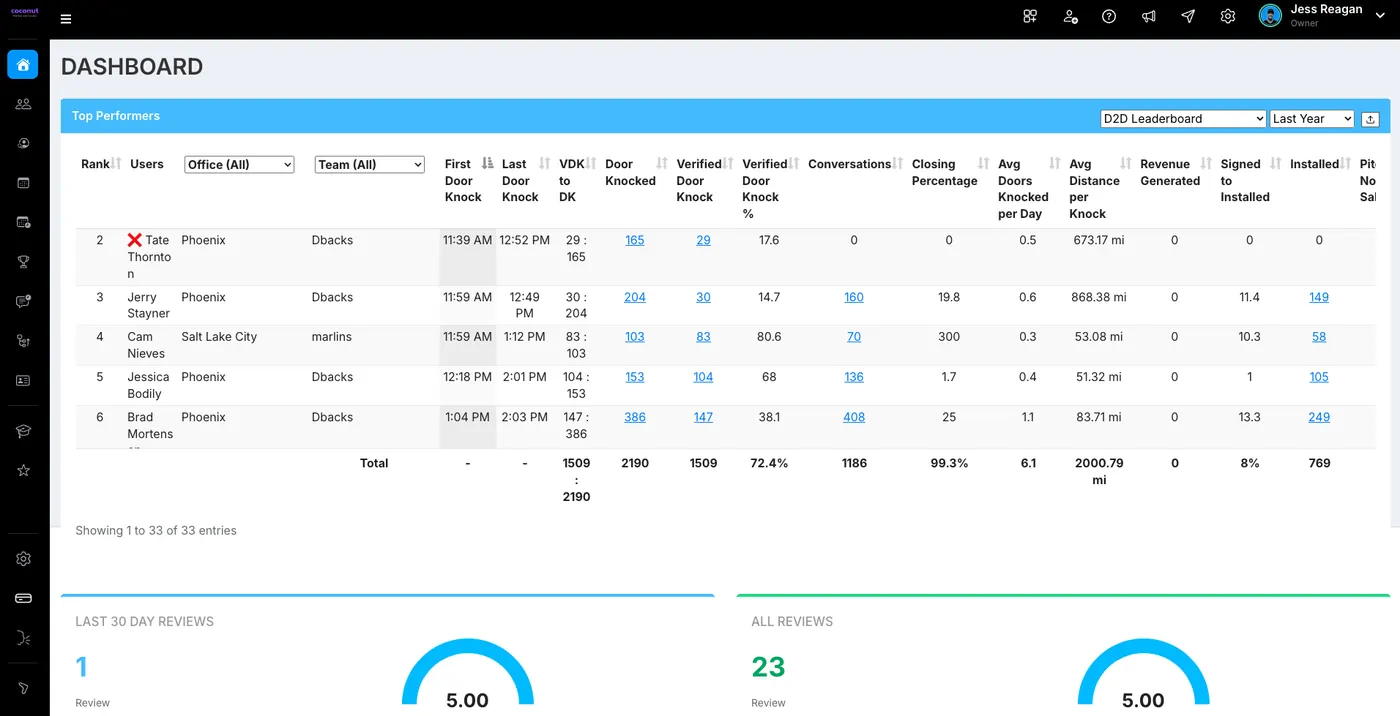
RepCard is an all-in-one Sales Operating System built for door-to-door home services teams. It puts lead capture, rep tracking, follow-up, and gamification in one app so your reps stop juggling four tools.
It was built for the field from day one, not adapted from an office CRM. A rep shares a digital card, captures the homeowner in seconds, and the follow-up fires on its own, while managers see who is knocking where in real time. It fits teams in roofing, solar, pest control, fiber, and HVAC, from two reps knocking to an org scaling past 30.
Key Features
- Digital Business Cards: Reps share contact info and capture homeowner details on a tap or scan, with every share tracked to the rep.
- Canvassing and territory tracking: Managers see who is knocking where in real time and stop two reps from hitting the same door.
- Automated Lead Management: Follow-up texts and emails fire on their own so no lead goes cold.
- Competitions and Leaderboards: Gamification drives more knocks and more sits, with activity scored fairly.
- Setter-to-closer handoff: Tracks the handoff so attribution stops getting blurry.
Pricing
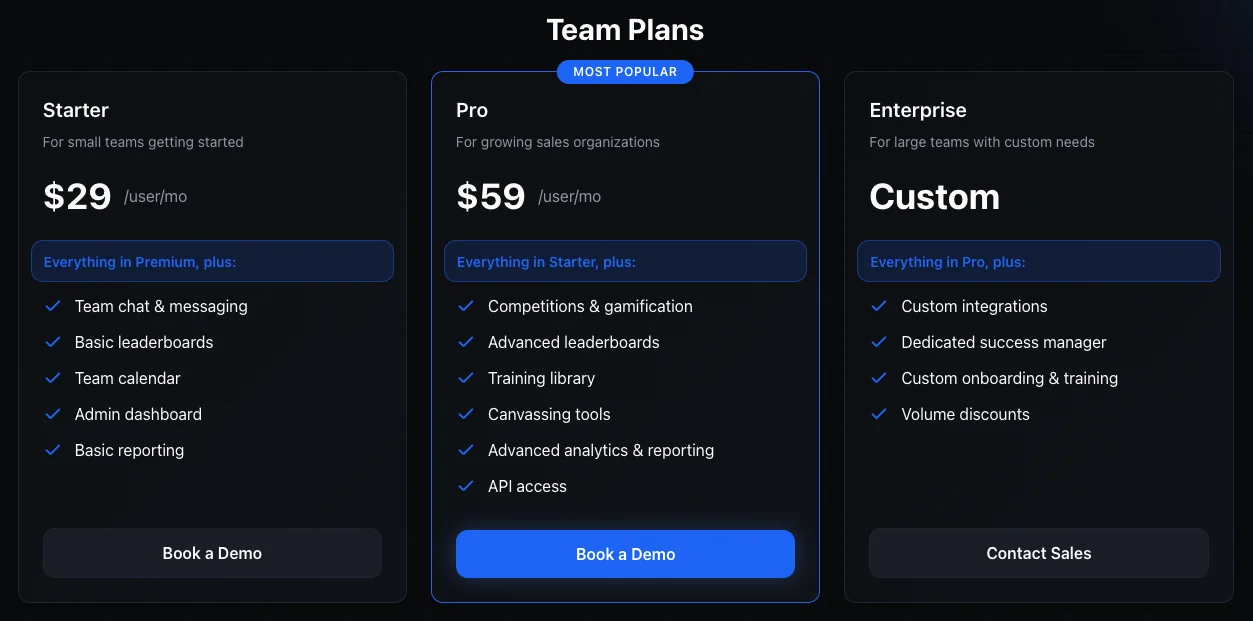
RepCard keeps pricing public and simple:
- Free personal plan at $0 for a single rep.
- Premium for individuals at $12/mo.
- Starter team plan at $24/user/mo.
- Pro team plan at $49/user/mo.
- Enterprise is custom. See full pricing.
Pros
- Built for door-to-door home services, not a repurposed office CRM.
- Simple enough that reps actually use it in the field, one-handed, in the sun.
- Replaces a stack of separate tools with one login.
- Public pricing with a free plan to start.
Cons
- Not a field service tool, so scheduling and invoicing after the sale need a separate system.
- Heavy in-home financing proposals need a dedicated proposal tool alongside it.
Ratings
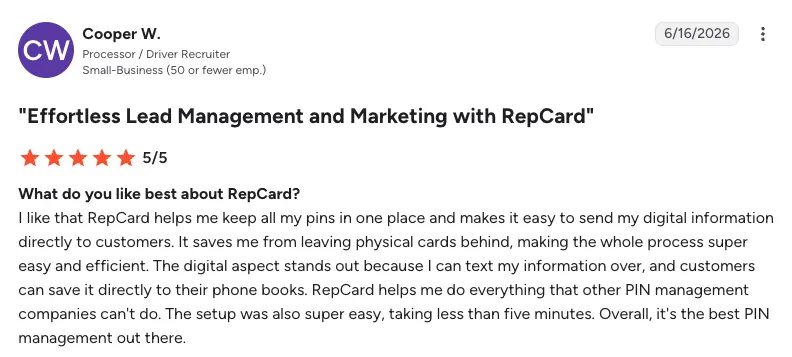
G2: 4.9/5. Reviewers call out the lead capture, automated follow-up, and support, with many D2D reps saying it is the rare tool their whole team actually opens.
2. SalesRabbit
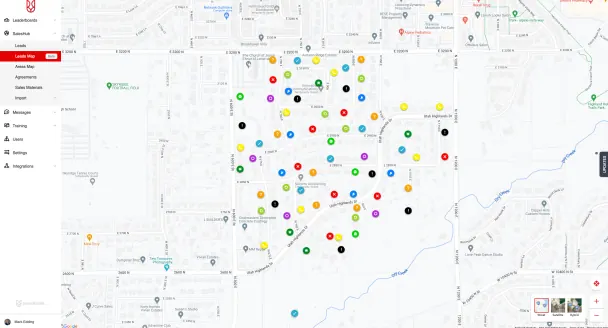
SalesRabbit is one of the most established door-to-door platforms. It covers canvassing, territory mapping, lead management, and digital contracts, and it is widely used across roofing, solar, pest control, and telecom.
If you want a well-known canvassing tool with mapping and contracts in one place, it checks those boxes. The tradeoff is cost and setup weight for smaller teams.
Key Features
- Canvassing and mapping: Maps territory and logs which doors got knocked to keep reps organized.
- Lead management: Tracks leads from the door through the pipeline.
- Digital contracts: Lets reps send and sign agreements in the field.
- Team tracking: Shows rep activity and location for managers.
Pricing
- Team from $41/user/mo with a three-user minimum.
- Pro from $55/user/mo with a ten-user minimum.
- A limited free tier is available.
Pros
- Broad D2D feature set in one platform.
- Long track record across home services verticals.
- Digital contracts built in.
Cons
- Reviewers regularly flag cost, especially once add-ons stack up.
- Team plan carries a three-user minimum.
- Can be more platform than a small crew needs.
Ratings
G2: 4.5/5. Reviewers rate the canvassing and mapping highly but often mention that pricing adds up.
3. SPOTIO
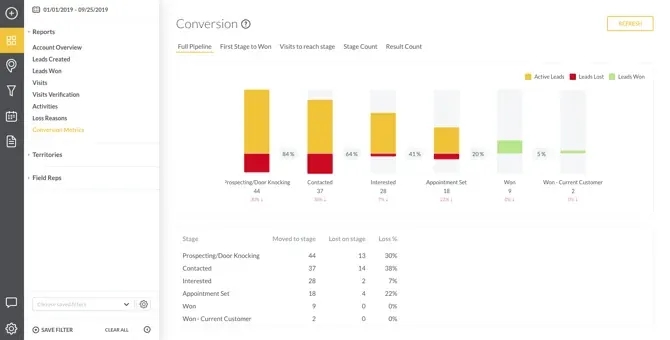
SPOTIO is a field sales engagement platform built for outside sales teams. Its strengths are territory management, activity tracking, and multi-channel follow-up across call, text, and email.
It fits mid-market and larger outside sales orgs that run structured field teams and want deep reporting. Smaller home services crews can find it heavier and pricier than they need.
Key Features
- Territory management: Assigns and maps territory for outside sales reps.
- Activity tracking: Logs rep activity and visits for manager visibility.
- Multi-channel sequences: Automates follow-up across call, text, and email.
- Reporting: Pipeline and activity dashboards for sales leaders.
Pricing
- Custom pricing, not published, with a five-user minimum.
- Entry plans start around $25/user/mo on an annual contract.
- Higher tiers run meaningfully more per user.
Pros
- Strong territory and activity management.
- Good reporting for structured outside sales teams.
- Multi-channel follow-up built in.
Cons
- Pricing is not public and requires a sales call.
- Five-user minimum and higher tiers get expensive.
- Leans to broad B2B outside sales over lean home services D2D.
Ratings
G2: 4.5/5. Reviewers praise territory tools and reporting, though several mention pricing and setup effort.
4. Sunbase
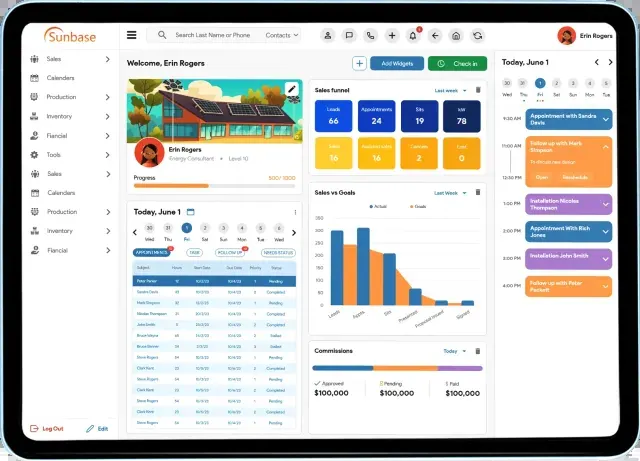
Sunbase is a CRM and field sales platform built for solar, roofing, and home improvement companies that want one system from canvassing to proposal to install. Its strength is range: it covers the sale and the project delivery in the same place.
That range is also the catch. Smaller teams that just want simple tracking can find it more platform than they need, and pricing is hidden behind a sales call.
Key Features
- Canvassing: Maps territory and logs door activity for D2D teams.
- CRM and pipeline: Tracks deals from lead to close.
- Proposals: Builds quotes and proposals inside the platform.
- Project management: Carries the job through to installation.
Pricing
- Custom pricing, not published. Contact sales for a quote.
Pros
- Covers sale through install in one system.
- Built for solar and roofing workflows.
- Handles the full cycle, not just canvassing.
Cons
- Pricing is hidden behind a sales call.
- Heavier than a small crew needs.
- Broad scope adds a learning curve.
Ratings
G2: 4.2/5. Reviewers like the all-in-one workflow, with some noting the platform takes time to learn.
5. Badger Maps
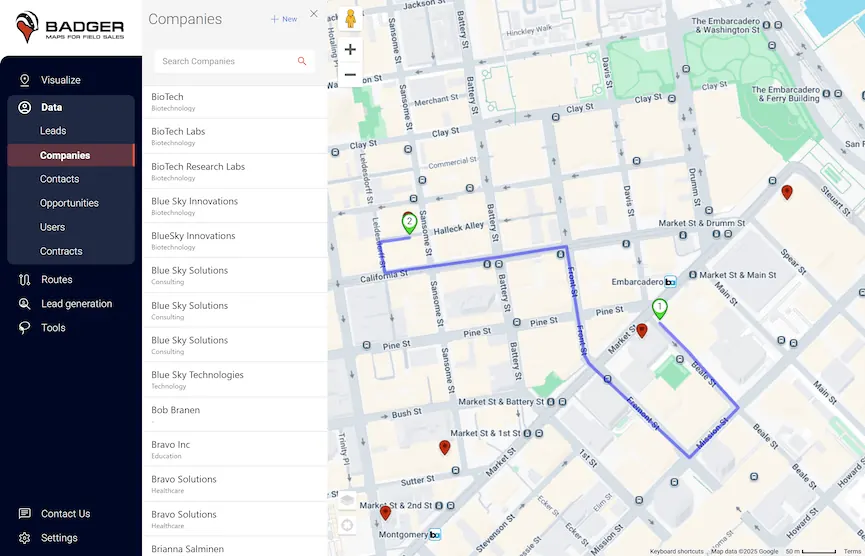
Badger Maps is a routing and territory tool for outside reps who spend the day in the truck. It plans efficient routes, maps accounts, and cuts windshield time.
It is a focused tool, not a full sales system. If driving efficiency is your bottleneck, it is strong at that one job. For door-to-door canvassing and rep management, it is not built for the whole motion.
Key Features
- Route planning: Builds efficient daily routes across accounts.
- Territory mapping: Visualizes accounts and territory on a map.
- CRM sync: Connects to common CRMs to pull account data.
- Reporting: Basic activity and check-in reporting.
Pricing
- From about $49/user/mo billed annually.
- Higher with territory management add-ons.
Pros
- Best-in-class route optimization.
- Cuts driving time for reps covering large areas.
- Strong support ratings.
Cons
- Not a canvassing or full field sales system.
- No gamification or setter-closer handoff.
- Costs climb with add-ons.
Ratings
G2: 4.7/5. Reviewers praise route planning and support, with pricing the most common gripe at scale.
6. Leap
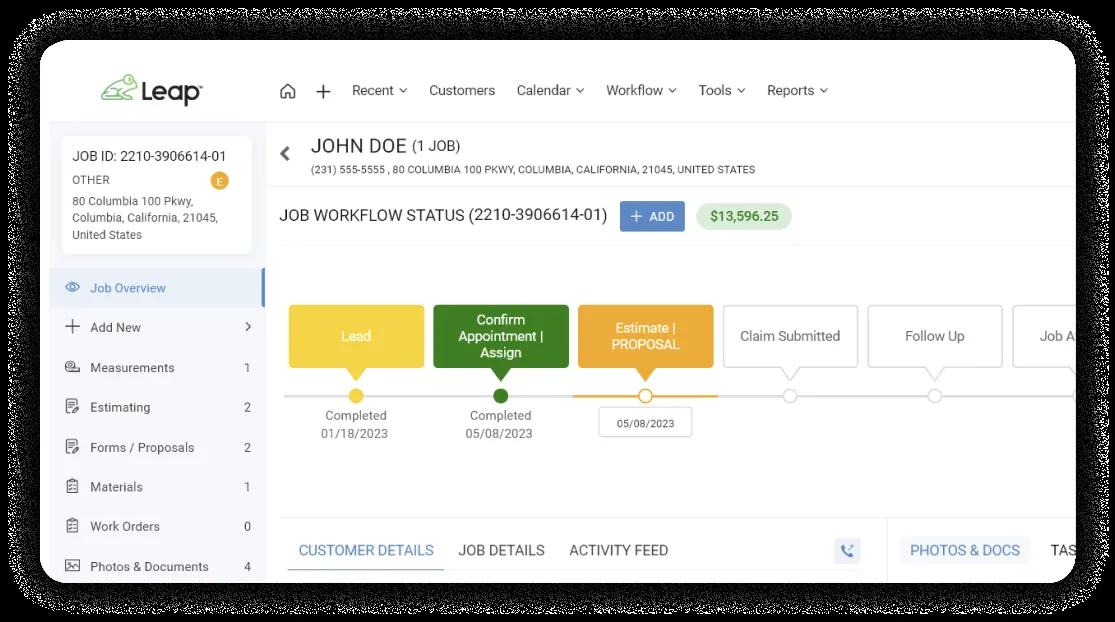
Leap is built for the kitchen-table close. Reps build good/better/best proposals, collect e-signatures, and run financing applications on the spot, so a closer can sign the deal without driving back to the office.
It is a closing and proposal tool, not a canvassing or rep-tracking system for a door-knocking team. If your reps present and close inside the home, that is where it earns its spot.
Key Features
- In-home proposals: Builds good/better/best pricing options to present in the home.
- E-signature: Captures signatures at the table.
- Financing: Runs credit applications across multiple lenders.
- Offline mode: Works without a connection from a mobile app.
Pricing
- CRM from $79/mo for one user.
- Team plan from $298/mo plus $99/mo per extra user.
- SalesPro from $750/mo for six users.
- Plans require a one-year contract.
Pros
- Strong in-home proposal and financing flow.
- Cuts back-office time for closers.
- Good/better/best pricing built in.
Cons
- Not a canvassing or rep-tracking tool.
- Requires a one-year contract.
- Pricing is not shown until you book a demo.
Ratings
G2: 4.3/5. Reviewers value the proposal and financing tools, with contracts and onboarding the common complaints.
7. JobNimbus
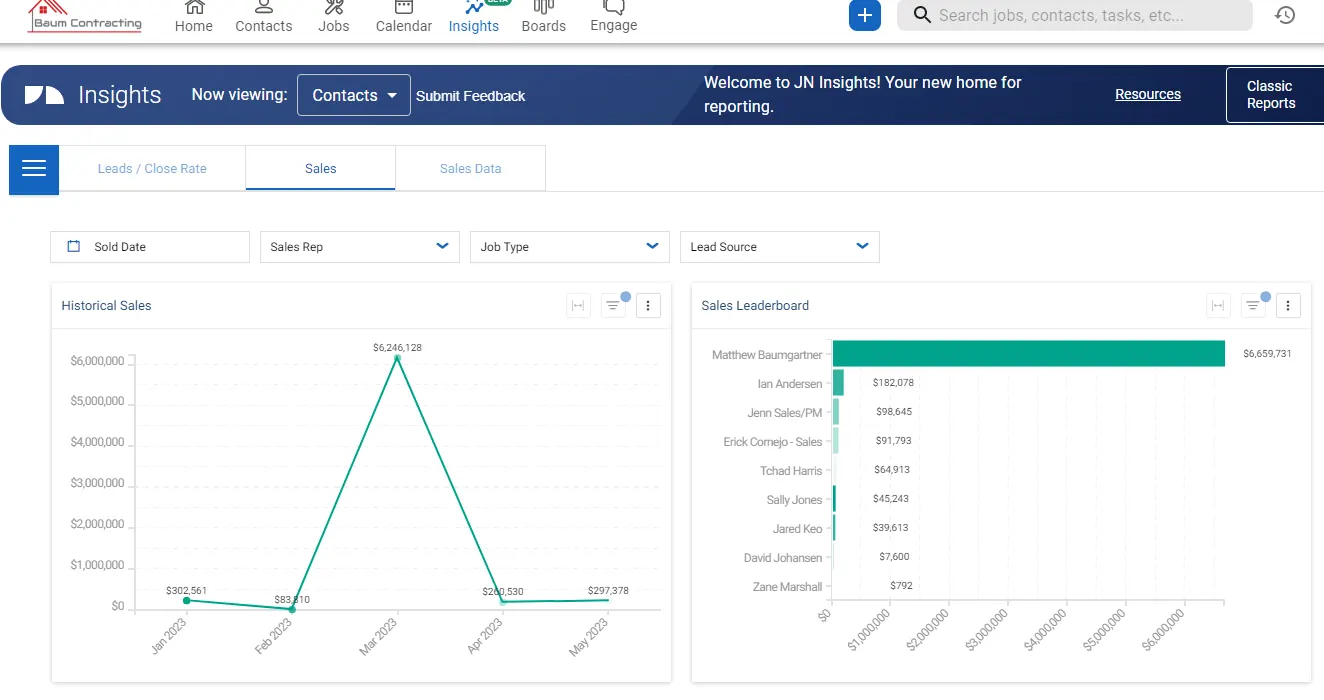
JobNimbus is a roofing CRM that combines sales pipeline with project management, so a roofing company can track a deal from lead to completed job. It straddles the sales and service line.
It fits roofing teams that want their pipeline and their production board in one tool. For a pure door-knocking motion in pest, fiber, or solar, a lot of it is built for a job workflow you may not have.
Key Features
- Roofing CRM: Tracks leads and deals through the pipeline.
- Estimating: Builds roofing estimates and proposals.
- Project management: Manages the job from sold to complete.
- Automation: Triggers tasks and updates across the workflow.
Pricing
- Custom quote, roughly from $49/mo for basic.
- Standard and premium tiers run higher.
- Includes a 14-day free trial.
Pros
- Sales and project management in one tool.
- Strong for roofing workflows.
- Free trial with no card required.
Cons
- Roofing-first and project-heavy.
- Less suited to pure D2D canvassing motions.
- Pricing requires a quote.
Ratings
G2: 4.7/5. Reviewers rate the roofing workflow highly, with setup depth the main learning curve.
8. Housecall Pro
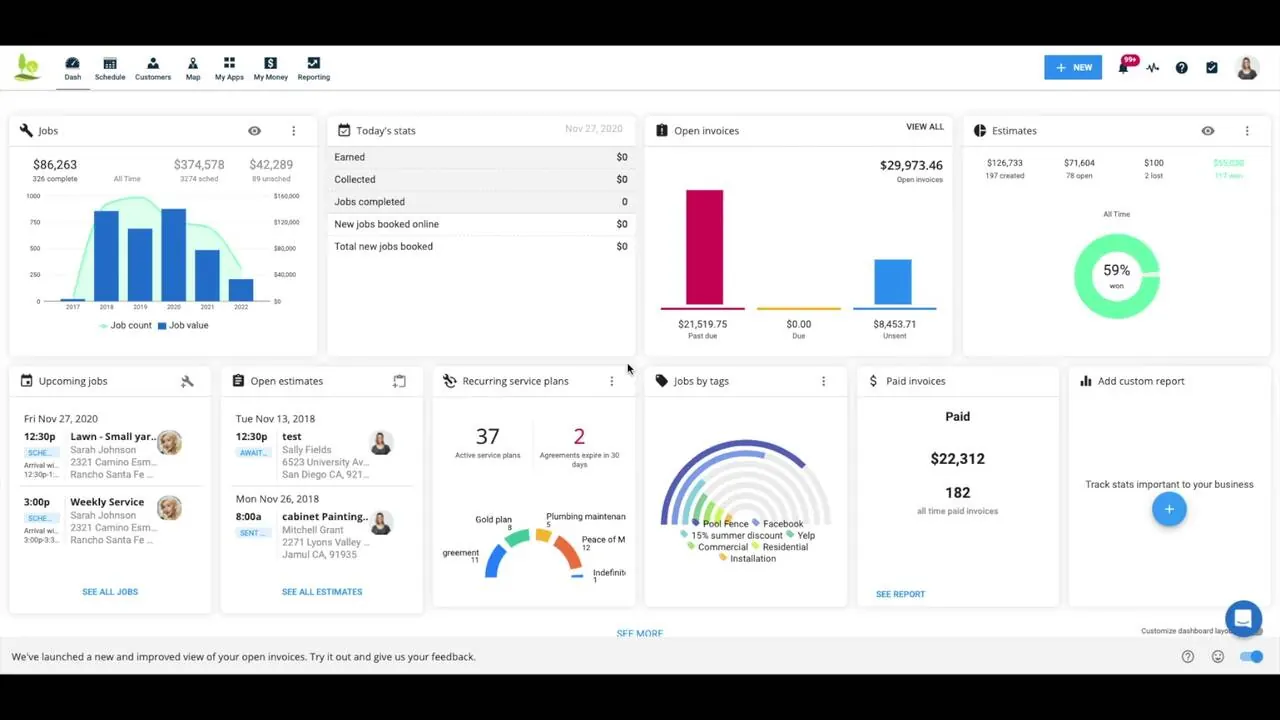
Housecall Pro is field service management software: scheduling, dispatch, and invoicing after the sale. We put it on the list so you can see the line clearly. This is the dispatch tool that sometimes gets sold as a CRM.
It is strong at running the crew after the deal is signed. It is not a selling tool, so it does not track door knocks, run canvassing, or manage a setter-closer pipeline.
Key Features
- Scheduling and dispatch: Books and assigns jobs to crews.
- Invoicing and payments: Bills customers and collects payment.
- Customer communication: Sends job updates and reminders.
- Reporting: Tracks completed work and revenue.
Pricing
- Basic at $79/mo.
- Essentials at $189/mo.
- MAX at $329/mo.
- Additional users at $35/mo each.
Pros
- Strong scheduling and invoicing for service work.
- Saves small service businesses real hours.
- All-in-one for post-sale operations.
Cons
- Not a field sales tool.
- No canvassing or rep pipeline.
- Per-user costs climb at the top tier.
Ratings
G2: 4.3/5. Reviewers rate it well for service operations, with tier jumps and added-user costs the main gripes.
Also Worth Knowing: Enzy and Paiv
Two more names come up in D2D circles. Enzy is a sales performance and gamification platform built around leaderboards, incentives, and team communication. Paiv (formerly Gamify) is a D2D tool that pairs gamification with AI voice note-taking at the door. Both lean toward motivation and performance tracking rather than full lead capture and canvassing, and neither publishes pricing or a public G2 rating, so you have to book a call to see numbers. Worth a look if gamification is your main gap, but confirm they cover the rest of your motion before you commit.
Field Sales Software vs. Field Service Software: What's the Difference?
Field sales software helps you win the deal. Field service software helps you deliver the job after the deal is signed. They get lumped together in every "best CRM" list, and that mix-up costs home services teams real money.
Field service platforms handle scheduling, dispatch, and invoicing. They are built for the crew that shows up after the sale. Useful, but they were never designed for a setter knocking doors or a closer sitting at a kitchen table.
Field sales software is built for the front of the deal: lead capture, rep tracking, follow-up, and the handoff from setter to closer. If your reps are in the field generating business, that is the tool they need in their hand. Buy a dispatch tool by mistake and you will wonder why your reps will not use it to actually sell.
Here is the quick test.
| Question | Field Sales Software | Field Service Software |
|---|---|---|
| Who uses it most? | Setters and closers | Office staff and crews |
| Main job | Capture and close deals | Schedule and complete jobs |
| Built for the door? | Yes | No |
| Tracks rep activity? | Yes, in real time | Rarely |
| Handles invoicing? | Sometimes | Yes, core feature |
In this list, RepCard, SalesRabbit, SPOTIO, Sunbase, Badger Maps, and Leap live on the sales side. JobNimbus straddles both. Housecall Pro is a field service tool, and we included it so you can see the difference clearly.
How to Choose the Right Field Sales Software for Your Team
Choose field sales software by matching it to your sales motion first, then your budget, then your existing tools. Skip the feature checklist. Start with how your reps actually sell.
Ask four questions. Do your reps knock doors or work inbound leads? Do they close in the home or set appointments for a closer? How many reps need it, and will they really use it? What do you already run that it has to work with?
The numbers show why fit matters. Sales turnover runs around 35%, roughly three times the rate of other industries, so software your reps abandon is money burned twice. And reps already spend less than a third of their week selling, so anything that adds admin makes the problem worse.
Here is what I tell every owner who calls us. The best software is the one your reps will actually open. We built RepCard because reps kept ignoring the heavy tools their managers bought. Lead with simplicity, prove it in a week, and adoption takes care of itself.
How Much Does Field Sales Software for Home Services Cost?
Field sales software for home services runs from free for a single rep up to $49 or more per user per month for a full team platform, with some tools charging $300 a month or more once you add seats. Most vendors hide the number behind a demo call, which is why this guide lists starting prices out in the open.
RepCard keeps it simple and public. There is a free personal plan, a $12/mo Premium plan for individual reps, and team plans at $24/user/mo (Starter) and $49/user/mo (Pro), with custom Enterprise pricing for larger orgs. You can see every tier and add-on on the pricing page. We publish it because when you hide pricing, someone else fills that gap with a wrong number.
The Bottom Line
The best field sales software for home services in 2026 is not the one at the top of someone's list. It is the one that fits how your reps sell and that they will use without being forced.
Three things to remember. Match the tool to your sales motion before anything else. Know the difference between a selling tool and a dispatch tool. And test adoption fast, because your reps cannot afford to fight their software.
If your motion is door-to-door in home services, that is exactly what we built RepCard for. Bring your real numbers and book a RepCard demo to see it work for your team.
Frequently Asked Questions
Small home improvement companies usually start in spreadsheets, then move to one mobile tool that captures leads and tracks reps without a heavy setup. Most teams are small, an owner plus two or three reps, so they want the easiest setup, the quickest rollout, and a price that does not need a contract negotiation. Start with the basics: knocks, leads, appointments, and close rate by rep. Add depth as you grow. The common mistake is buying enterprise software built for 300 reps when you have four.
The top options in 2026 are RepCard for an all-in-one door-to-door sales system, SalesRabbit and SPOTIO for broad field sales and territory management, Sunbase for solar and roofing end-to-end, Badger Maps for routing and territory, Leap for in-home proposals and financing, JobNimbus for roofing sales plus project management, and Housecall Pro for post-sale scheduling and invoicing. The right pick depends on whether you need a selling tool, a proposal tool, or a service tool.
Field sales software helps you win the deal. It handles lead capture, rep tracking, follow-up, and the setter-to-closer handoff for reps in the field. Field service software helps you deliver the job after it is sold, with scheduling, dispatch, and invoicing. Home services teams often buy a service tool by mistake and then wonder why their reps will not use it to sell.
It ranges from free for a single rep to $49 or more per user per month for a full team platform. Some tools run $300 a month or more once you add users. RepCard team plans start at $24/user/mo, with a free personal plan and a $12/mo option for individual reps. Many competitors hide pricing behind a demo call, so confirm the number on the vendor's page before you buy.
They do when the app is simple enough to use one-handed in the sun. Adoption is the whole game. Reps abandon tools that take too many steps or feel built for the office, which is why the best field sales software leads with fast lead capture and simple tracking, not a wall of features. Test adoption in the first week before you commit the whole team.
Yes. Most field sales platforms connect to the CRM, calendar, and communication tools you already run so you avoid double entry. RepCard offers integrations plus API access on its Pro plan, so your field data flows into the systems your office already uses. Check that any tool you consider connects to your current stack before you switch.
Related RepCard Features
Related Articles

The Four Pillars of a Sales Operating System
A Sales Operating System unifies recruiting, training, selling, and marketing for field sales teams. See why fragmented tool stacks cost you reps.
Read more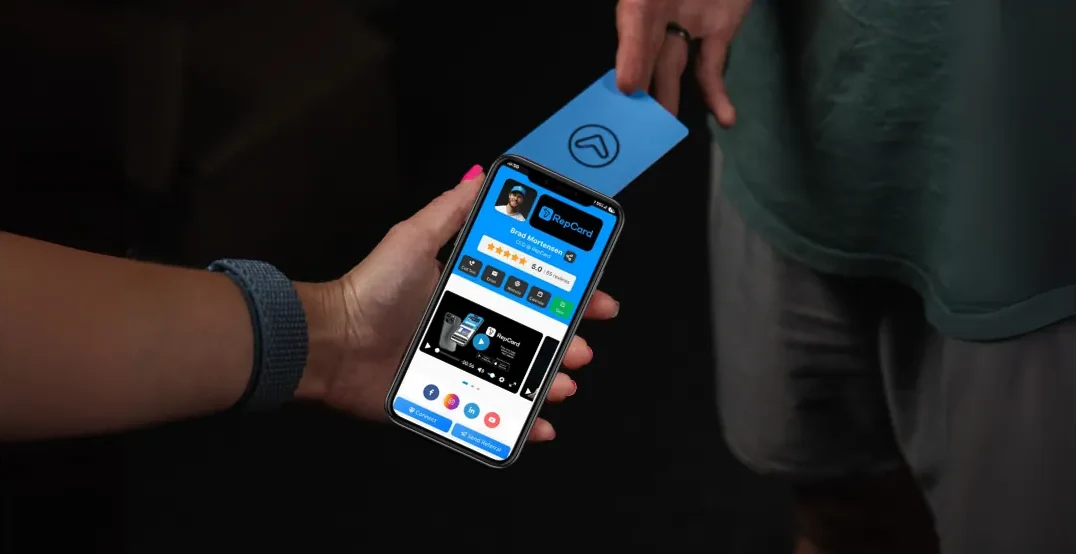
Best Digital Business Card Platforms in 2026
We evaluated 9 digital business card platforms on sharing, analytics, CRM, and team management. See which fits your team in 2026.
Read more
7 Best SPOTIO Alternatives for D2D Sales Teams in 2026
SPOTIO is a strong field sales platform, but it's not the only option. Compare 7 alternatives ranked by what D2D sales managers actually need in 2026.
Read more