TL;DR
The fastest way to fail with door-to-door field sales software is to buy it and hope reps use it. Adoption is the variable that decides whether you get ROI in 90 days or write the software off as a sunk cost. This is the exact 30-60-90 day plan we run with home services teams: what to measure, what to ignore, what to tie to comp, and how to diagnose adoption when it stalls.
Why door-to-door sales app adoption fails in the first 30 days
Door-to-door sales app adoption fails because most teams measure logins instead of behaviors. Gartner has reported a roughly 50% failure rate on CRM implementations for years, and user adoption is the number one cause, not the software itself (Johnny Grow CRM failure analysis).
Here's what fails on most rollouts. The team imports leads. Managers send a Slack message. Reps log in once on day one. Two weeks later the dashboard shows 80% "active users" because everyone tapped the icon. The pipeline hasn't changed. Nobody's followed up faster. Nobody's logged more doors. The tool is decoration.
This is the gap between login adoption and behavior adoption. Login adoption is what every sales software vendor sells you in the demo. Behavior adoption is what produces revenue.
The pattern compounds. SaaS research shows that 30 to 40% of product features go unused within 90 days of rollout (SaaS Factor adoption metrics). For a field sales app, that means the activity tracking, the follow-up automation, and the analytics that justified the purchase are dead by quarter's end.
A real adoption plan defines behavior first, then builds a 30-60-90 day cadence around the specific actions that produce revenue. That's what the rest of this guide gives you.
What ROI should I expect from door-to-door sales software in the first 90 days?
Expect break-even by day 60 and 2x to 3x payback by day 90 if you run a real adoption plan. Without a plan, expect to spend the same money and get nothing back, the same outcome 78% of sales teams hit when they missed quota in 2025 (Salesforce State of Sales).
Here's the math on a 20-rep solar team at $50 per rep per month:
- Software cost: $1,000 per month, $3,000 for the quarter
- Each rep follows up on 5 leads per week that would otherwise die (the dropped follow-up problem is well documented, average B2B lead response time is 42 hours and only 7% of companies respond within 5 minutes per Harvard Business Review research on 2.24 million leads)
- At a 2% door-to-door close rate (Field Sales Tools benchmark data) and $8,000 average order value, that's 0.4 extra deals per rep per month, $3,200 per rep per month in incremental revenue
- Team uplift: $64,000 per month, or $192,000 for the quarter
- Net 90-day ROI: 63x on software cost, before factoring in any close rate improvement from better territory management
That math only works if the follow-ups actually happen. If reps don't change behavior, the spreadsheet is fiction.
The competitor pages that tout 312% revenue increases and 6,000% ROI in three days aren't math, they're marketing. The real number depends on one variable: do your reps actually use the tool the way the tool is designed to be used.
What makes it hard to track door-to-door sales software activity?
Activity tracking breaks because the data you collect (logins, taps, screens viewed) doesn't map to the behaviors that produce revenue. Track three categories of activity and skip the rest:
1. Door behaviors. Doors knocked, doors logged with outcome, contact details captured at the door. If a rep knocks 80 doors and logs 12, you have a tracking gap, not an activity gap.
2. Follow-up behaviors. Time from door interaction to first follow-up. Number of touches per lead. Method (text, call, email). The 5-minute window matters because firms that responded within 5 minutes were 100 times more likely to connect with the lead and 21 times more likely to qualify it than firms that waited 30 minutes (Harvard Business Review study).
3. Pipeline behaviors. Leads progressed from cold to warm. Appointments set. Deals closed with app attribution. This is the lagging indicator that proves the leading indicators are working.
Salesforce's 2024 State of Sales found that reps spend only 28 to 30% of their time on actual selling activities (source). The reason isn't laziness, it's that the admin and tracking layer of most field tools is built for managers, not reps. A good door-to-door field sales app inverts that. The rep gets a one-tap flow that captures door, outcome, follow-up trigger, and pipeline stage in the same motion as the conversation.
If your tool requires more than 30 seconds of admin per door, your activity data will be incomplete by month two.
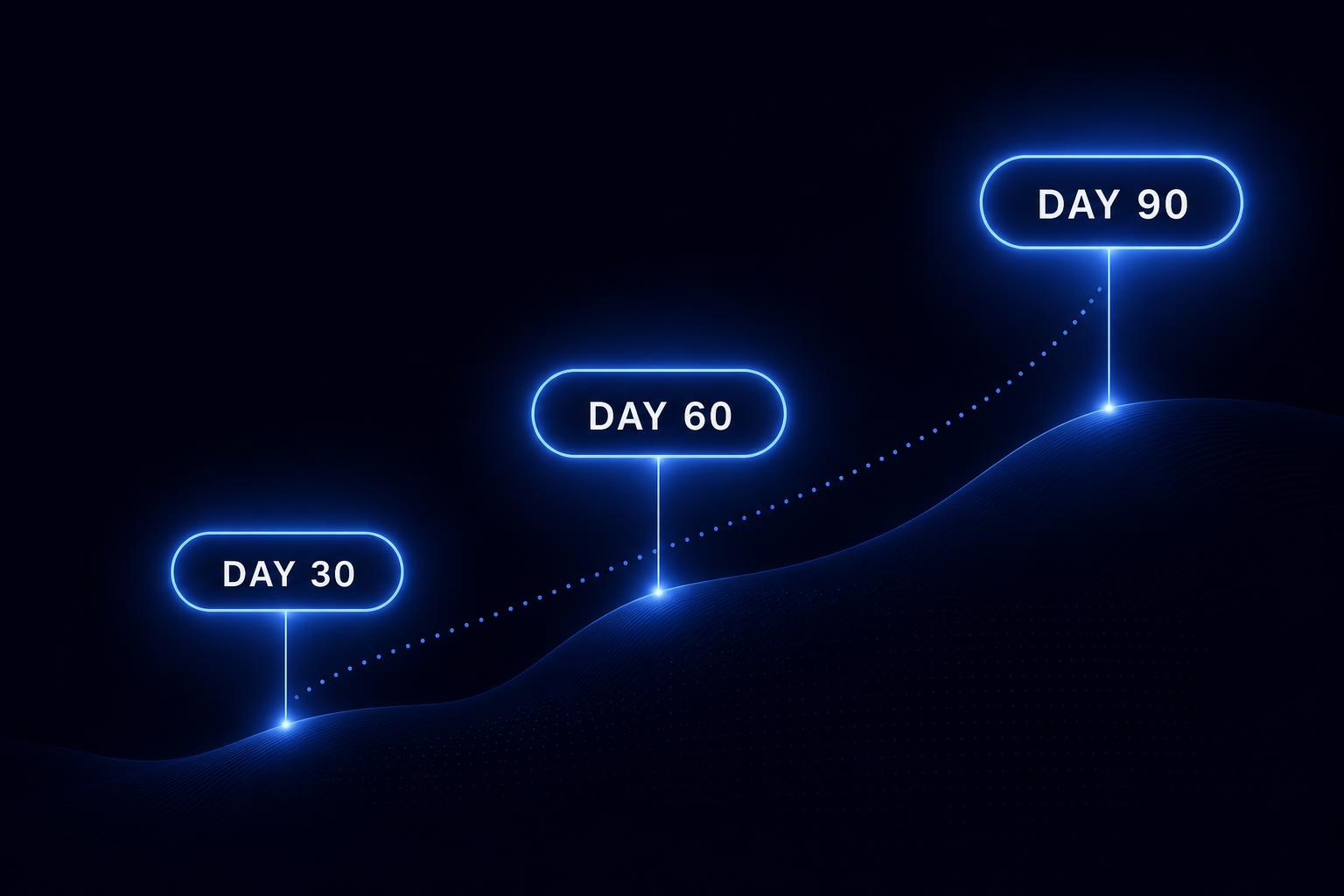
The 30-60-90 day adoption plan
Three phases. Each has one goal, three KPIs, and one manager ritual.
Days 1-30: Foundation phase
Goal: 80% of reps active daily by day 30.
KPIs to hit:
- Daily login rate per rep
- Lead capture rate per door knocked
- Time from interest signal to first follow-up (target: under 5 minutes)
Manager ritual: Daily 5-minute standup using app data. Not a vibe check. Yesterday's doors, today's plan, any rep below activity threshold gets a same-day 1:1.
The first 30 days are about installing the habit, not optimizing the outcome. Don't try to measure ROI yet. Measure whether the tool is being used the way it's supposed to be used. Activation under 7 days predicts 78% retention at 90 days, while activation taking 30 or more days drops retention to 41% (SaaS Factor activation benchmarks). Speed of activation is the most important variable in this phase.
Days 31-60: Behavior phase
Goal: 75% of reps hitting all three activity gates each week.
KPIs to hit:
- Doors logged per rep per day (set the floor based on industry: solar 50, pest control 70, roofing 40)
- Follow-up rate within 24 hours (target: 90%)
- Profile shares or digital business card sends per rep per week
Manager ritual: Weekly scorecard published team-wide. Names. Numbers. No commentary. The scorecard becomes the social proof that the tool is the way work gets done.
This phase is where most teams quit. The data looks worse before it looks better because you're now measuring real activity instead of self-reported activity. Don't panic. Don't add features. Don't change the tool. Hold the line on the activity gates.
Days 61-90: Outcomes phase
Goal: Pipeline attribution working. Every closed deal traces back to a logged interaction.
KPIs to hit:
- Leads sourced through the app (vs. side-channel leads)
- Deals closed with app attribution
- Revenue per rep per logged interaction
Manager ritual: Biweekly 1:1 review using the app data as the source of truth. Coaching conversations get specific because the data is specific.
By day 90, you should be able to answer one question with confidence: how much revenue did this rep produce because of the app, not in spite of it? If you can't answer that, the adoption plan didn't work and you're looking at the wrong KPIs.
How do door-to-door teams use field sales software effectively?
Effective use means the app is part of the daily standup, the weekly scorecard, and the comp plan. If those three things don't reference the app, reps will never fully adopt it. The Forrester Activity Study tracked 3,031 sales reps and found the average rep loses nearly two full days per week to administrative tasks (source). The reps who win that time back are the ones whose managers built the tool into the daily operating cadence.
The three operating rituals that drive real adoption:
Daily standup. Five minutes. Manager pulls up the dashboard. Yesterday's activity per rep. Today's plan. Any rep below the floor gets coached before they leave for the field, not in a Friday wrap-up when the week is gone.
Weekly scorecard. Posted in the team channel every Monday. Top performer named. Bottom performer named. No spin, no euphemism. This works because field reps are wired for competition. The leaderboard is the tool, not just a feature in the tool.
Comp plan tie. Adoption gets paid. Specifics in the next section.
The teams that skip these three rituals get the worst possible outcome: they paid for software, their reps complain about extra work, and the data is too thin to make decisions from. Three months in, they're back to spreadsheets.
How to tie field sales software adoption to your comp plan
Pay for activity in the ramp period, then pay for outcomes after. Specifically:
Weeks 1-4: $250 per rep for hitting daily activity gates 5 out of 5 days. Small enough that the team can't argue it's unfair. Large enough that reps care.
Weeks 5-8: $500 per rep for hitting all three weekly KPIs (doors logged, follow-up rate, profile shares).
Weeks 9-12: Standard commission, but with a 10% accelerator for deals that have full pipeline attribution in the app.
The reason a ramp bonus beats a punishment: sales rep turnover runs about 35% annually, three times the average across industries, and replacing a rep costs around $115,000 once you factor in recruitment, training, and lost ramp (sales compensation research). The math says spend $750 in adoption bonuses to keep a rep who's worth $115,000 to replace. That's not a sales decision. That's accounting.
Punishment-based comp ties (lose your commission if you don't log activity) push reps to game the data. They tap the buttons without doing the work. The dashboard gets prettier and the pipeline gets emptier. Pay for adoption, then pay for outcomes.
What to do when 90-day adoption stalls
If you hit day 90 and adoption hasn't moved, work through this diagnostic in order. Don't skip steps.
1. Are managers using the data daily? If managers only look at the dashboard before the Monday meeting, reps will only use the tool on Monday. Adoption follows attention. No manager attention, no rep adoption.
2. Is comp tied to adoption? If reps make the same money whether they log doors or not, they'll choose not to. Comp ties don't have to be huge. They have to be present.
3. Are activity gates specific and measurable? "Use the app more" is not a gate. "Log every door with outcome and follow-up trigger" is. If you can't argue about whether a rep hit the gate, the gate is wrong.
4. Is the friction technical or behavioral? Have your top rep walk you through their day with the app. If it takes more than 30 seconds to log a door, you have a product problem (talk to the vendor) or a workflow problem (the rep is using it wrong). If they fly through it but you still can't see the data, the data layer is broken. If the workflow is clean but reps still don't use it, you have a behavior problem and the answer is in steps 1, 2, and 3.
Most teams that stall on adoption fail at #1. Manager attention is the load-bearing input. Everything else is downstream.
The Booma Effect of getting adoption right
What you put into the process comes back. When you invest in the daily rituals that make the tool work, the team learns that the tool is how decisions get made, how money gets earned, and how performance gets measured. The trust compounds. The data gets cleaner because reps trust the data. The coaching gets sharper because the data is real. The pipeline gets predictable because the leading indicators actually lead.
That's the difference between a team that bought sales software and a team that runs on it.
The door-to-door teams pulling away from their competition in 2026 aren't the ones with the most features. They're the ones whose reps actually use the tools they have, every day, in the same flow, with the same data, that managers use to coach and that comp plans use to pay. That's not a software problem. That's a process problem. And it's solvable in 90 days if you build the plan around behaviors instead of buttons.
Ready to see what a built-for-D2D field sales app looks like when adoption is baked into the rollout? Book a demo.
Key Takeaways
- 1Most adoption failures come from measuring logins instead of behaviors.
- 2Run a 30-60-90 plan: foundation, behavior, outcomes, with one goal and three KPIs per phase.
- 3Pay $250 in weeks 1-4 and $500 in weeks 5-8 for hitting activity gates, then commission with a 10% attribution accelerator.
- 4Daily standups, weekly scorecards, and comp ties are the three rituals that drive real adoption.
- 5When adoption stalls at day 90, the diagnostic almost always points to manager attention first.
Frequently Asked Questions
Expect break-even by day 60 and 2x to 3x payback by day 90 if you run a real adoption plan with daily manager rituals, weekly scorecards, and a comp plan tie. Most ROI comes from faster follow-ups (the 5-minute window matters), more doors logged with outcome, and better territory routing. Without an adoption plan, expect zero return.
The data most apps collect (logins, taps, screen views) doesn't map to revenue-producing behaviors. Track three categories instead: door behaviors (knocks, captures), follow-up behaviors (speed, touches), and pipeline behaviors (leads, appointments, deals). Skip everything else. If your app requires more than 30 seconds of admin per door, your data will be incomplete by month two.
Effective teams build the app into three daily and weekly rituals: a 5-minute daily standup using app data, a public weekly scorecard with named KPIs, and a comp plan that ties small bonuses to hitting activity gates in the first 60 days. If those three rituals don't exist, the software won't drive results regardless of feature set.
Foundation-level adoption (80% daily active) takes 30 days with active manager attention. Behavior-level adoption (75% hitting weekly activity gates) takes 60 days. Outcome-level adoption (pipeline attribution working) takes 90 days. Without a structured plan, full adoption typically never happens.
Yes, but pay for activity in the ramp period and outcomes after. Specifically: $250 for hitting daily gates in weeks 1-4, $500 for hitting weekly gates in weeks 5-8, then a 10% commission accelerator for deals with full app attribution in weeks 9-12. Punishment-based comp ties push reps to game the data instead of doing the work.
Login adoption means reps opened the app. Behavior adoption means reps changed how they work because of the app: faster follow-ups, more doors logged, every interaction captured. Login adoption is what most software dashboards show. Behavior adoption is what produces revenue. The gap between the two is the reason 50% of CRM implementations fail.
Track deals with full pipeline attribution: the door interaction was logged in the app, the follow-up was sent through the app, and the appointment was set inside the workflow. Compare revenue per app-attributed deal against revenue per side-channel deal. If app-attributed deals close faster, larger, or at higher rates, that's the lift. If they don't, the app isn't driving outcomes and the adoption plan needs work.
Related RepCard Features
Related Articles

What Is a Sales Operating System for Field Teams
A Sales Operating System (SOS) is a unified platform that combines recruiting, training, canvassing, scheduling, and team management in one place, eliminating the need for fragmented tools. Field sales teams using an SOS report higher close rates, faster onboarding, and better visibility.
Read more
D2D Sales Rep Onboarding: How to Ramp a New Hire in 30 Days
Most D2D sales reps quit in the first four weeks — not because the work is too hard, but because no one gave them a structured path to early success. Here's the 30-day onboarding framework that cuts early turnover and builds reps who stick.
Read more
Recruit, Train, and Keep D2D Sales Reps in Home Services
Recruiting, training, and keeping field sales reps aren't three separate problems. They're one system. A systems approach cuts turnover 25-35% and gets reps to quota up to 50% faster.
Read more