TL;DR
ServiceTitan and FieldRoutes run your operations: scheduling, dispatch, billing. They were not built to run your field sales team. RepCard connects to both and adds the part they skip: capturing leads at the door, following up in seconds, and showing managers who's actually knocking. Keep your platform. Add the sales layer.
TL;DR
ServiceTitan and FieldRoutes run your operations: scheduling, dispatch, billing. They were not built to run your field sales team. The sales software that integrates with them adds the part they skip: capturing leads at the door, following up in seconds, and showing managers who's actually knocking. RepCard connects to both and feeds clean lead data straight into your system. Keep your platform. Add the sales layer.
Your reps knocked a hundred doors today. Your field service software knows about almost none of it.
That's the gap. You went looking for a sales CRM integration that works with ServiceTitan or FieldRoutes because the platform running your business does a lot, but it doesn't run your field sales team. It tracks jobs, not knocks. It schedules techs, not setters.
In 2026, more home services companies run on ServiceTitan or FieldRoutes than ever. The field service management market hit $5.1 billion this year. These platforms are good at what they were built for. The problem shows up the second a rep is standing on a porch with a hot lead and nowhere fast to put it.
This post breaks down what sales software actually integrates with ServiceTitan and FieldRoutes, why those platforms leave a sales-shaped hole, and what to add so leads stop dying in the gap.
What sales software integrates with ServiceTitan and FieldRoutes?
Two kinds of tools integrate with ServiceTitan and FieldRoutes. First, native marketplace apps for the back office: accounting, payments, and marketing add-ons like QuickBooks, Zapier, Mailchimp, and Twilio. Second, a dedicated field sales layer that captures leads at the door and pushes them into your system. RepCard is the second kind.
The marketplace integrations are real and useful. ServiceTitan runs a leads integration platform that pulls booking requests from sources like Google Local Services and home warranty partners. FieldRoutes connects to the usual operations tools through its own marketplace and API.
But notice what every one of those does. They move office data around. None of them put a tool in your rep's hand at the door. That's the difference between a sales CRM integration and an operations integration, and it's the whole point of this post.
Why ServiceTitan and FieldRoutes don't cover the field sales side
ServiceTitan and FieldRoutes are field service management platforms. They run the office: dispatch, scheduling, routing, invoicing, customer history. They were never built for the rep canvassing a neighborhood. That's not a knock on them. It's just not their job.
Think about who each tool was designed for. ServiceTitan was built so a dispatcher can move techs around a map and a back office can bill clean. FieldRoutes, now a ServiceTitan company, was built to run recurring pest control and lawn routes. Both are strong at that work.
What field service software does well
Field service software manages the job after it's sold. It handles scheduling, dispatch, route optimization, customer records, invoicing, and recurring billing. If you run a pest control or HVAC operation with techs in trucks, you need it. Ripping it out would be a mistake.
The catch is that all of that starts after a deal exists. The platform assumes the lead is already in the building. Getting it there is somebody else's problem.
Where leads and rep activity fall through the cracks
Leads fall through the cracks in the hours between a knock and a follow-up. Most companies are slow here, and slow kills deals. Harvard Business Review's audit of 2,241 companies found the average first response took 42 hours, and 23% never responded at all.
Now picture that inside a field service tool that nobody on your sales team logs into from a porch. A rep talks to a qualified homeowner, scribbles a name on a notepad or drops it in a group text, and moves to the next door. By the time it reaches the system, the homeowner has already talked to two other companies.
The same blind spot hits your visibility. You can't see how many doors got hit, how many people your reps actually talked to, or who's coasting. The data a manager needs to coach lives in the field, and your FSM never sees it.
What a sales layer should add on top of your field service software
A sales layer adds three things your field service software skips: lead capture at the door, automated follow-up in seconds, and live visibility into rep activity. Together they close the gap between a knock and a booked job. Without them, leads sit unworked and managers run blind.
Capture means the rep logs the lead on their phone the moment they're standing there, with the address and contact attached. Follow-up means a text or email fires automatically, not whenever someone remembers. Visibility means you see knocks, conversations, and set appointments by rep, in real time, without chasing anyone for a report. We get deeper into automated cadences in our field sales follow-up guides, but the principle is simple: speed beats everything.
How fast does follow-up need to be?
Fast. Speed is the single biggest lever in field sales follow-up. Harvard Business Review found that companies contacting a lead within an hour were seven times more likely to have a meaningful conversation than those that waited even 60 minutes longer. The widely cited MIT Lead Response Management study pushed it further: your odds of qualifying a lead crater once you slip past the first few minutes.
A rep can't hit that window by hand. They're knocking. Automated follow-up does it for them, the second the lead is captured, while the homeowner still remembers the conversation.
How RepCard integrates with ServiceTitan and FieldRoutes
RepCard connects to FieldRoutes with three credentials: your API key, a token, and your domain URL. An admin adds them under Settings > FieldRoutes, picks the branch, and the accounts are linked. The full FieldRoutes setup steps live in RepCard's help center. No engineer. No long onboarding.
Once the accounts are linked, you choose which service types reps can sell, so a rep can't quote termite work you never authorized, and you build a pricing table with price floors so discounts stay inside your limits.
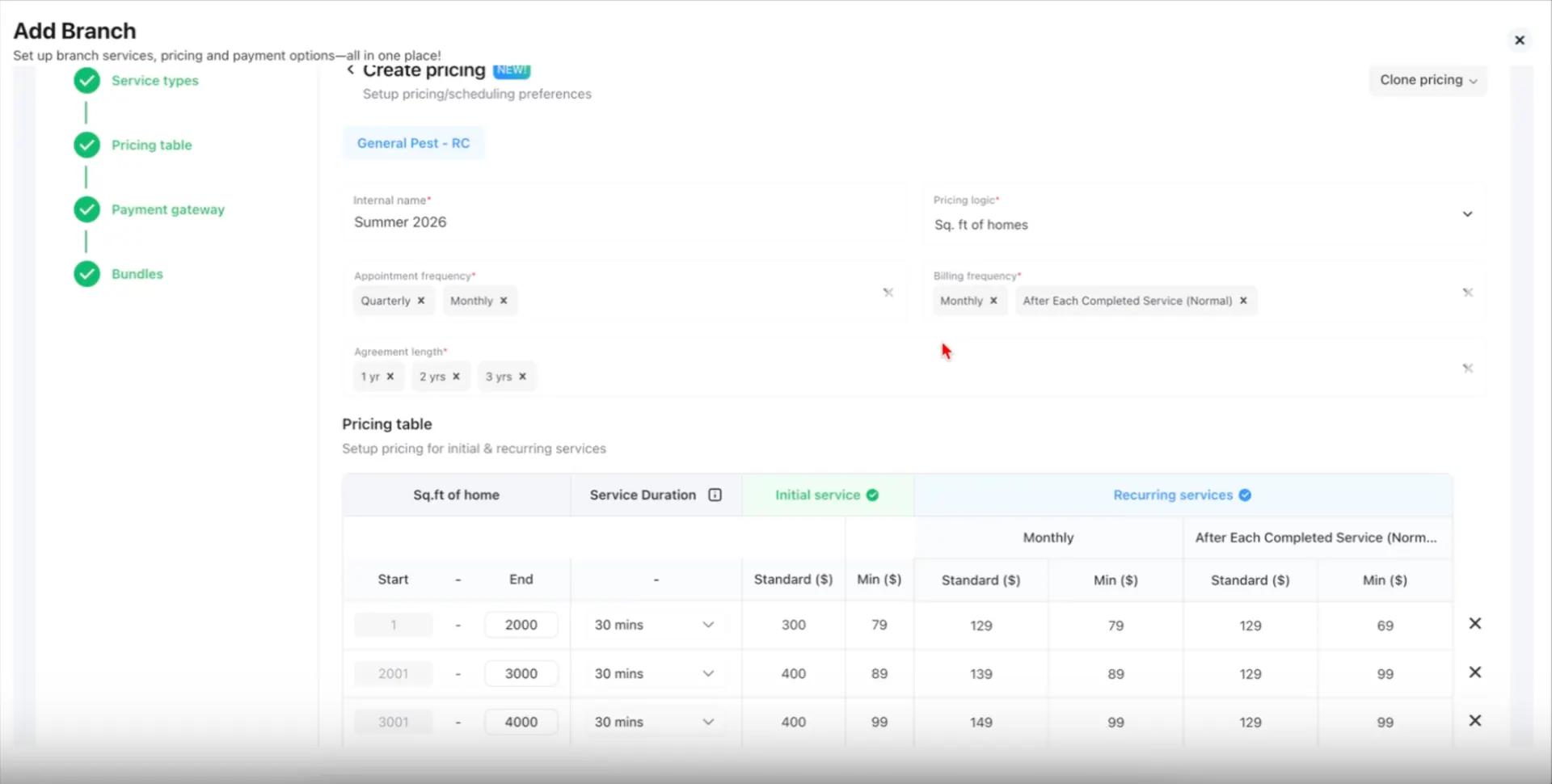
Here's the pricing setup inside RepCard. You define a standard price and a minimum price for each square footage range, set the appointment and billing frequency, and lock the agreement lengths reps can offer. A rep can discount down to the floor, never below it.
Then comes the part ServiceTitan and FieldRoutes don't hand your reps. A rep taps a property on the map, builds the agreement, applies pricing within the floors you set, takes payment, and books a real technician time slot based on live availability. The customer signs on the device and gets the contract emailed. That record flows into FieldRoutes so the office can service and bill it. Reps sell at the door. The office keeps its system. Nobody re-keys anything.
ServiceTitan connects a little differently. RepCard links to it through Zapier, so when a rep sets an appointment in RepCard, the matching booking gets created in ServiceTitan automatically. Same idea, lighter touch: the sale starts in the field and the schedule lands in your platform without anyone typing it twice. You can check the current connections on RepCard's integrations page.
That's the part that matters. Your reps get a tool built for the door. Your office keeps the system it already runs on. The short version is: RepCard handles the selling, your FSM handles the service, and the two talk.
Should you replace your field service software? No.
No. Don't rip out ServiceTitan or FieldRoutes. They run your operations well, and replacing a platform your whole office knows is a painful, expensive move you don't need to make. The fix is to add a sales layer on top, not to swap platforms.
RepCard sits beside your field service software and feeds it. Your dispatchers and billing team keep their system. Your reps and managers get a tool built for canvassing, lead capture, and follow-up. Two jobs, two tools, one connection between them.
How do you track door-to-door reps without more data entry?
You automate the logging so reps barely touch it. Double entry is the fastest way to kill adoption. Reps won't fill out a second system, and they shouldn't have to. Salesforce's State of Sales research found reps spend less than a third of their time actually selling, with the rest lost to admin and manual work.
RepCard logs activity as reps go: doors hit, contacts made, appointments set, all from the phone in their pocket. The manager gets the dashboard. The rep gets to keep knocking. Nobody combs through a spreadsheet on Sunday night. If you want the numbers, RepCard's pricing is built around team size so a four-person crew isn't paying like a 300-rep org.
The Bottom Line
Three things to take away. First, ServiceTitan and FieldRoutes are operations platforms, not field sales tools, and that gap is where leads die. Second, the sales software that integrates with them should add door-side capture, instant follow-up, and rep visibility, the parts your FSM was never built to do. Third, you don't replace your platform, you add a layer on top and connect the two.
That phone number attached to that address is money. Money to you and money to your reps. Don't let it sit in a notepad while a competitor calls first. See RepCard running on your ServiceTitan or FieldRoutes setup and watch what happens when no lead gets dropped.
What you put into the field comes back. Capture it.
Frequently Asked Questions
Not really. ServiceTitan includes CRM features for managing jobs, calls, and bookings inside the office, but it wasn't built for outside reps canvassing neighborhoods. There's no door-side lead capture or rep activity tracking made for the field. That's the gap a dedicated field sales tool like RepCard fills, and it connects back to ServiceTitan so the data lands where your office needs it.
FieldRoutes integrates with operations tools through its marketplace and API, including QuickBooks, Zapier, Mailchimp, and Twilio. For the sales side, RepCard connects to FieldRoutes using an API key, a token, and your domain URL. Once linked, reps capture and work leads in the field and the clean records flow into FieldRoutes for scheduling and billing.
Not in a way built for the field. Both platforms track jobs and techs once work is scheduled, but neither was designed to show how many doors a rep knocked or how many homeowners they actually talked to. A field sales layer captures that activity automatically from the rep's phone and reports it to managers in real time.
Field service software runs the job after it's sold: scheduling, dispatch, routing, and billing. A field sales CRM runs the work before the sale: capturing leads at the door, following up fast, and tracking rep activity. ServiceTitan and FieldRoutes are field service platforms. RepCard is the sales layer that handles the selling motion and feeds the result into your FSM.
No. RepCard works alongside ServiceTitan and FieldRoutes, it doesn't replace them. Your office keeps running operations on the platform it already knows. Your reps get a tool built for canvassing and follow-up. The integration connects the two so leads captured in the field move into your system without double entry.
Related RepCard Features
Related Articles

7 Best SPOTIO Alternatives for D2D Sales Teams in 2026
SPOTIO is a strong field sales platform, but it's not the only option. Compare 7 alternatives ranked by what D2D sales managers actually need in 2026.
Read more
How to Bulk Import Leads in RepCard's New Import Flow (2026)
Bulk import leads into RepCard with the new flow. Map columns, assign owners, handle duplicates, and route leads to subcompanies in one workflow.
Read more
9 Field Sales Software Pricing Models for Teams 10–50
Field sales software pricing for 10-50 rep teams: 9 models, per-rep vs flat, monthly vs annual, and the math that decides which one fits.
Read more