TL;DR
Most door-to-door teams build their follow-up strategy on a stat from 1942 that was never independently verified. What actually decides whether a deal closes in 2026 is speed, not touch count. Leads contacted within an hour are seven times more likely to reach a real decision maker, so build a same-day cadence, run it out of one system, and track whether reps actually complete it.
In this guide:
- The reason door-to-door teams lose deals
- The sales follow-up stat everyone quotes, and why it's misleading
- Speed to lead is what wins
- The follow-up cadence that actually works for door-to-door teams
- Tracking whether your reps are actually following up
- Multi-channel coordination without dropping the ball
- What to say in a follow-up message
- Building a follow-up culture on your team
- The bottom line
- Turn your follow-up cadence into a system, not a task list
- Get the system right, and the follow-up becomes automatic
The reason door-to-door teams lose deals
Your reps knock on 50 doors a week. They talk to maybe 15 people. Three of them say "call me back." By Friday, how many of those three have actually been called back?
If you're running it like most teams, the answer is one. Maybe.
In 2026, that gap between "said they'd follow up" and "actually followed up" is still the single biggest leak in most home services sales operations. Not lead generation. Not the pitch. The follow-up.
The reason isn't laziness. It's friction. Your reps are in the field. Their CRM is in the cloud. By the time they get back to the office, the lead goes cold. By the time they manually enter it into a spreadsheet or an old platform, they've already moved on to next week's doors.
That's not a people problem. That's a systems problem. And systems, unlike people, you can actually fix.
Automatic reminders for every hot prospect are what turn "I meant to call them back" into "I called them back today." Without reminders firing in the moment, when a rep is thinking about where to knock next, the follow-up doesn't happen. That's not a rep failure. That's a platform failure.
Here's the tough part: if your follow-up system isn't built for field work, your reps won't use it. They'll keep using their phone, their memory, and their guilt.
The sales follow-up stat everyone quotes, and why it's misleading
You've heard the number: 80% of sales happen after the fifth contact.
That stat gets copied everywhere. Sales blogs. LinkedIn posts. HubSpot reports. It sounds like gospel. So teams build entire follow-up strategies around hitting someone five, six, seven times, and if it hasn't worked by then, they move on.
Here's what you actually need to know about that 80% number: it came from a 1942 survey run by a small chapter of the National Sales Executives Association in Long Island, New York. The sample size was under 40 sales reps. One study. In 1942.
And you know what happened next? That stat got "widely distributed, copied and pasted" for 80 years, according to SMEI's own successor page, and it was never independently re-verified at scale. Nobody ran a modern study to see if it still held.
Build your follow-up system on what actually works in the field today, not on a number from before your grandmother was born.
And here's the part that should really bother you: this kind of bare, uncited percentage isn't rare in sales content. It's the norm. Invespcro claims only 44% of reps follow up after a single "no" on one part of its page, meaning the majority give up after that first rejection, and separately, that 70% of salespeople stop after one email on another. Two different claims about two different behaviors, sitting on the same roundup, and neither one cites a source. That's not research. That's the same telephone game the 80% stat has been playing for eight decades, just with more numbers in it.
The real driver of follow-up success isn't the count. It's the speed.
Speed to lead is what wins
Here's what the modern data shows. In March 2011, Harvard Business Review published an analysis by James Oldroyd, Kristina McElheran, and David Elkington looking at how fast companies responded to leads and what happened when they did, across 2,241 U.S. companies. The finding, as cited by LeanData: firms that contacted leads within an hour were seven times more likely to have a meaningful conversation with a key decision maker than those who waited even one hour longer.
Seven times more likely. For waiting one hour.
Companies that waited 24 hours or more? They were 60 times less likely to qualify the lead at all.
That's not just D2D. That's enterprise sales, B2B, the whole lot. And the reason is simple: when you reach out fast, you break preoccupation. The prospect is still thinking about the problem you solve. They haven't already called three other companies.
That same principle showed up even earlier in a 2007 study by Dr. James Oldroyd (then a faculty fellow at MIT's Sloan School of Management) and InsideSales.com, presented at MarketingSherpa's B2B Demand Generation Summit that October. Researchers analyzed three years of data across six companies, more than 15,000 leads, and more than 100,000 call attempts. The result: contact odds fell off more than tenfold within the first hour of a lead coming in, and the odds of qualifying that lead dropped roughly 21-fold when response time stretched from 5 to 30 minutes.
Five minutes to thirty. That's what the qualification difference looks like in the field.
There's one more number worth knowing, because it explains why speed beats persistence. According to lead response time data cited by Vendasta, drawn from a Lead Connect survey, 78% of customers buy from the company that responds to their inquiry first. Not the company with the best price. Not the company that followed up the most times. The one that showed up first.
That's the whole game in door-to-door. You already showed up first, at the door. The question is whether you show up first in the follow-up, too, or whether you let a competitor's rep beat you to the callback.
LeadAngel, a lead management vendor, states, without citing a source, that leads reached within 5 minutes are 21 times more likely to turn into customers than leads contacted after half an hour. That's an unsourced vendor claim, not an academic study, so treat it as directional rather than gospel. But it points the same way as everything else: the clock starts the second the door closes behind your rep.
So stop thinking about the fifth touch. Start thinking about the first touch happening within the hour, ideally within minutes.
The follow-up cadence that actually works for door-to-door teams
Here's what a real D2D cadence looks like for a team running their reps in the field with a platform that keeps up with them.
Same day (within 2 hours of the knock):
- Text message with a quick value prop. "Hey [name], this is [rep name] from [company]. Stopped by your place on [street name] earlier today. We do [one-line description]. Free inspection/quote if you're interested. Lmk. Thanks."
- Digital business card link sent via text. Saved contacts flow into your pipeline automatically. No double entry, no missed leads.
Day one (if no response to text):
- Follow-up call if they don't respond.
Day three:
- Another text or call. Different angle. "Haven't heard back. Just wanted to make sure you got my info. Open this week for a free estimate?"
Day seven:
- Repositioning message. "Helping a lot of folks on your street right now. Wanted to make sure we get on your calendar before we're booked up."
Day 14 and beyond (for longer-cycle verticals like solar or commercial roofing):
- Nurture sequence. Alternating touchpoints across text, email, and call. Content shifts to objection handling ("You don't have to decide today, but...") or social proof ("Here's what we just did two blocks over").
A short, dense burst of touches over the first week after a knock, so a lead the rep couldn't reach at the door doesn't fall through the cracks.
Light check-ins spread over a long horizon for a lead who isn't in-market right now but might be later.
Reviving a lead that has gone cold, stopped responding, or hasn't been talked to in months.
Promotion-driven touches timed around a company's own seasonal offer, time-boxed to that offer's window.
Four example flows built from the same text, email, and delay building blocks. Not in-product templates. Every timing shown is illustrative and rep-configurable.
The speed part is critical. If you're not hitting that same-day text within two hours, you're playing catch-up from the start. Once the prospect has talked to your competitor or moved on, the cadence doesn't matter as much.
Team chat with unified in-app messaging means your reps and your follow-up team can coordinate without dropping context. Read receipts and push notifications mean you're not chasing people via email wondering if they saw it. "When I close a deal, I can share it instantly with the whole team," says Derek Thompson at SafeHome Security. That instant visibility works the other direction too. When a lead needs a follow-up touch, the whole team knows it without a status meeting.
This cadence isn't one-size-fits-all across every vertical you might run. RepCard's own vertical pages show why.
On the roofing side, inspection leads go cold within 48 hours without a follow-up system, which is why storm-season teams lean hard on the same-day text.
Solar runs a longer sales cycle. Long cycles mean leads go cold before reps follow up if there's no system forcing the issue. That's why the day 14-and-beyond nurture step matters more there than it does in roofing.
Pest control has a different problem entirely. Recurring contract renewals get missed without a follow-up system, so the cadence needs a repeat cycle built in, not just a one-time push to close.
HVAC service leads have their own failure mode. Without follow-up, service call leads don't convert into signed contracts, because the homeowner's furnace problem feels urgent for about three days and then it's someone else's problem.
Same cadence skeleton. Different muscle depending on what you sell.
Tracking whether your reps are actually following up
You can't manage what you don't measure.
Most teams run a follow-up system in theory and a chaos system in practice. Reps "intend" to follow up, but nobody's tracking whether they did. By the end of the month, nobody knows which leads got touched and which ones rotted.
Start here: measure follow-up velocity. That's the percentage of new leads that get touched within 24 hours. If you're below 60%, you've got a system problem. If you're above 80%, you're running tight.
Next: measure follow-up cadence completion. Of the leads that need a day three touch, what percentage actually get it? Same for day seven, day 14. If you're tracking this, you can see exactly where the system breaks down.
Last: measure the correlation between touch count and close rate. Don't assume one more touch helps. Look at your own data. For your team, in your vertical, what's the pattern? Is it four touches? Six? Ten?
The only benchmark that matters is your own data. But you can't see your own data if your system isn't capturing it. If your follow-up tracking lives in someone's Gmail or a spreadsheet that never gets updated, you're flying blind.
This is where most teams' "CRM" quietly becomes a graveyard. Reps enter a lead once, at the door, if they remember to. Nobody updates it after that. A real contact management system needs to work the other way: saved contacts flow into the pipeline automatically, no double entry, no missed leads, no manual cleanup, and real-time notifications fire the moment a prospect opens the digital card you handed them. That second one matters more than it sounds like it should. A prospect reopening your card three days after the knock is a buying signal. If nobody on your team sees that signal in real time, you miss the exact moment to call.
Multi-channel coordination without dropping the ball
Your reps are using text, calls, and email. Your inside team might be using different tools. Your calendar is disconnected from your CRM or not connected at all. And somewhere in that mess, leads fall through the cracks.
Industry benchmarks commonly cited across sales-cadence research suggest a typical B2B cadence runs somewhere around 17 to 21 days with 8 to 12 touchpoints across channels. That's a reasonable starting point for a longer-cycle home services sale. It's way too slow for the first touch, which needs to happen same-day, not day three of a three-week plan.
Multi-channel means coordinating across all the channels. Not using all of them at once. That's spam.
Here's the part nobody talks about: most home services companies aren't actually short on tools. They're drowning in them. A canvassing app for the knocking. A separate CRM for the pipeline. A group chat for the team. A calendar app that doesn't talk to any of it. Most home services teams we talk to are running three, four, sometimes five separate tools just to manage field sales. Every handoff between those tools is a place a follow-up dies. That's not a follow-up problem. It's a stitched-together stack problem. The fix isn't "try harder." It's "run this out of one system."
The sequence looks like this: text first (fastest to reach them). Call if they don't respond. Email as a middle option when they don't answer calls. Calendar coordination with automated reminders to cut no-shows so you're not losing appointments to people who forgot they had them.
Two-way Google and Outlook sync means when you send a calendar invite, it goes into their actual calendar, not just a platform notification they'll miss.
The killer: make sure one person or one system owns whether a lead has been touched. If your rep enters it one way and your inside team sees it another way, you'll touch the same prospect three times and miss someone else entirely.
Here's what that failure actually looks like in the field.
A roofing rep knocks a door, gets a "call me next week," and texts himself a reminder. His manager is running a separate inside-sales push on aged leads. He doesn't know that prospect already has a rep assigned. So he cold-calls the same homeowner from a different number three days later. The homeowner gets two different people from the same company asking about the same roof in one week.
That's not persistence. That's disorganization. It's the kind of thing that makes a homeowner call your competitor instead, because at least the competitor has their act together.
The flip side is just as real. Elijah Palmer, a sales manager at Western Sun Solutions, put it plainly after a system caught a lead he almost let slip: he'd landed an extra account that week that he "probably would have lost" without it. That's the whole point of tracking follow-up instead of hoping reps remember it. The deals you almost lose never show up on a report. You only find out about them when the system catches one before it falls through.
The fix isn't a stricter rule. It's one system where the knock, the text, the call, and the calendar invite all write to the same record. Nobody duplicates. Nobody drops it.
What to say in a follow-up message
You have 5 seconds. Your prospect is looking at your text or your voicemail in the carpool line, and they're deciding whether you're worth a callback.
Don't sell. Don't pitch. Don't make it long.
Say: "Hey [name], this is [your name] from [company]. We were in your neighborhood today and talked about [the thing they cared about]. I grabbed your info so we can get you a quote/inspection/estimate this week. Can we set up a time?" Stop.
That's it. You gave them a reason (we talked about it today), you kept it fast (quote this week), and you gave them a call to action (can we set up a time). No fluff.
If they don't respond, the day three message is different: "Haven't heard back. Want to make sure we get on your calendar before we book up. Still open for that appointment?"
The day seven message: "Helping a lot of folks on your street right now. Wanted to check in once more before we move to the next block. Open this week?"
The angle changes because the context has changed. But the structure stays the same: context, proof of why they should care, and a clear ask.
That structure changes shape on a phone call, but not the logic behind it. If they pick up: "Hey [name], it's [your name], I stopped by earlier today about [the thing]. Got a couple minutes? I want to walk you through what I quoted and answer anything that came up after I left." Slower than the text, more room to handle an objection live, but the same job: remind them who you are, remind them why they cared, ask for the next step.
If it goes to voicemail, keep it under 20 seconds: "Hey [name], it's [your name] from [company], following up on our conversation earlier today about [the thing]. No rush, just wanted to make sure you had my number. I'll shoot you a text too. Talk soon." A voicemail that runs long gets deleted before it finishes. A voicemail that sounds like a form letter gets ignored. A voicemail that sounds like the person you actually met at the door gets a callback.
Building a follow-up culture on your team
The cadence only works if your reps run it. And your reps will only run it if you make it automatic, simple, and tracked.
Automatic means they don't have to think about it. A reminder fires. They follow it. In practice, that looks like this: a rep marks a door "interested, follow up" while they're still standing on the porch. The platform queues the same-day text automatically, sets the Day 1 call reminder without anyone typing it into a calendar, and flags the lead as "hot" on the team dashboard. The rep never opens a separate app to make any of that happen. It happens because they did the one thing they were already doing: logging the knock.
Simple means the system doesn't get in the way. They can knock on 20 doors, and by the time they get back to the office, everything is already queued up for follow-up.
Tracked means they can see how they're doing against it. "You've got 12 hot leads waiting for follow-up." Not "You need to follow up better."
That's the difference between a follow-up system and a follow-up grind. One sticks. The other burns people out.
The bottom line
"Eighty percent of sales happen after the fifth contact" is the wrong number to build a system around. "Seven times more likely to have a real conversation if you respond within the hour" is the right one.
Build a same-day follow-up system. Text and a digital card within two hours. Call the next day if they don't respond. Keep a consistent cadence going out. Track it. Measure it. Adjust based on what your own data shows.
That's field-proven. It works in roofing, solar, HVAC, pest, fiber, everything. The speed part is universal. The cadence changes a little by vertical, but the principle doesn't.
Your reps are already out there knocking. Now make sure the follow-up happens before the lead gets cold.
Turn your follow-up cadence into a system, not a task list
Everything above works if someone actually runs it, every time, for every lead, without missing a step. That's the hard part. A cadence that lives on a whiteboard or in a rep's head falls apart the first busy week.
RepCard's Lead Management is built to run that cadence for you. Reps build a custom sequence mixing text and email in whatever order the cadence calls for (same-day text, a day three follow-up, a day seven check-in). RepCard sends it. Leads enroll automatically the moment a rep sends their digital business card, or you can enroll a contact manually from any profile. Nobody has to remember to start the sequence by hand.
Reps set their own delay and timing between each message, then RepCard handles the send from there. The timing decision happens once, at setup, instead of every single day for every single lead.
Real-time notifications close the loop. Reps get alerted the second a lead engages, across more than two dozen triggers: card views, referrals, appointment changes, and more. A prospect reopening that digital card three days after the knock turns into a phone call, not a missed signal. That's the speed advantage the rest of this cadence depends on.
That's what separates a cadence you hope your team follows from a system that runs itself. Lead Management is how you make sure every lead gets its full run of touches, whether the rep remembers or not.
Get the system right, and the follow-up becomes automatic
RepCard was built from the field up for door-to-door teams. That means automatic reminders, real-time data capture so the rep doesn't have to go back to the office to log activity, and a 50% reduction in scheduling time so the follow-up doesn't get buried in logistics.
Here's what reps tell us actually works:
"Share info fast, stay organized, and get alerts when prospects engage. RepCard makes follow-up easy," says Jose Ochoa, insurance agent at PHP Agency.
"Built-in cadences mean instant follow-up after knocking, without paying another vendor. RepCard just works," according to Michael Claeys, energy consultant at LGCY Power.
"RepCard keeps every detail, address, contact, follow-up, so I can prospect all day without doubling back. It just makes life easier," shares Milad Parmanesh, account manager at SunRun.
The follow-up works because the system gets out of the way. The reps do the work. The platform just makes sure they don't forget to do it.
Ready to see what that looks like? Book a demo.
Key Takeaways
- 1Speed to lead beats touch count: responding within an hour makes a real conversation seven times more likely
- 2The '80% need 5 follow-ups' stat comes from a 1942 survey under 40 reps and was never re-verified
- 3Run a same-day text within 2 hours, then Day 1 call, Day 3, Day 7, and Day 14+ nurture for longer cycles
- 4Track follow-up velocity (percentage of new leads touched within 24 hours) and cadence completion by stage
- 5Run the knock, text, call, and calendar invite out of one system so nothing dies in a tool handoff
Frequently Asked Questions
A prospect is most receptive within the first hour after talking to you. After 24 hours, their attention has moved on, and you're competing with three other companies who also called them. Hitting them fast breaks preoccupation. Once they've already called someone else or made a decision, more touches won't help.
Solar typically runs 14-21 days from first contact to close. The same-day text still matters, but the spacing between touches is longer. You're doing day one, day three, day seven, day 14, and day 21 if they haven't closed. Each touch has a different angle: first is just breaking preoccupation, middle ones handle objections, final ones are urgency. Shorter cycles like HVAC can compress this to 5-7 days.
Track it with data, not surveillance. Measure percentage of leads touched within 24 hours, cadence completion rate by stage, and close rate by follow-up count. Show them the numbers weekly: 'You're at 72% same-day follow-up this week. Let's get to 85%.' That's accountability without the police feeling.
Once you've hit someone across multiple channels (text, call, digital card) with no response over a week or two, it's time to stop chasing and start nurturing. Put them in a longer-cycle sequence where you're sending value, not asking for the sale: an inspection tip, a market update, a win story from similar homes on their street. Once a month, not once a day. If they re-engage, you have another chance. If not, you've freed up your team to focus on warmer leads.
The speed part is the same: get to them within the hour. The cadence is different because your goal is a calendar block, not a close. Three touches in four days is often enough for appointment setting: one text, one call, one final text. After that, you're annoying them. For direct sales like one-call-close deals, the cadence is longer because objection handling takes more time.
Automatic reminders so the rep gets notified, activity logging so every touch gets recorded, calendar sync so appointments are real and don't get double-booked, and simple reporting so you can see follow-up velocity without building a custom report. Most teams don't need every bell and whistle. They need the follow-up system to get out of the way and let the rep do the follow-up.
Related RepCard Features
Related Articles
Best Contact Management Software for Sales
Stop losing leads to disorganized contact management. Compare the best contact management solutions for sales teams and learn what features matter most.
Read more
First-Knock Mastery: One-Call Close
Stop leaving deals on the table. Master the art of the one-call close with proven door-to-door techniques that convert first conversations into signed contracts.
Read more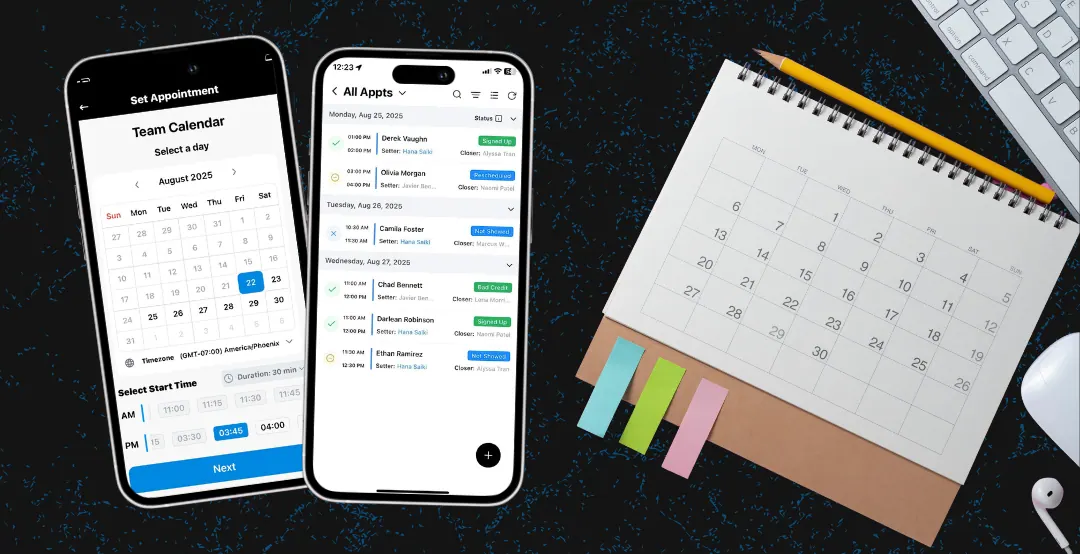
Best Calendar Scheduling App for Sales
Stop playing phone tag with prospects. Find the best calendar scheduling app to streamline appointments and close more deals.
Read more